Milwaukee M12 Ratchet vs M12 FUEL Ratchet: Which Is Better? (November 2026)
For the M12 ratchet vs M12 FUEL ratchet choice, pick the 2457-20 if you already have M12 gear and use 3/8-inch sockets. Choose the FUEL 3/8-inch kit to start a battery setup, or the 2566-20 for fast work with 1/4-inch sockets.
On this page (11 sections)
- M12 ratchet vs M12 FUEL ratchet: what actually changes?
- Who should buy the standard Milwaukee 2457-20?
- Who should choose the FUEL 3/8-inch kit?
- Who should choose the FUEL 2566-20?
- Does drive size matter more than the FUEL label?
- How much should speed and torque affect your choice?
- Which ratchet will fit your work area?
- How should you set up an M12 ratchet for its first job?
- What mistakes should you avoid with either ratchet?
- How do you care for an M12 cordless ratchet?
- Which M12 ratchet vs M12 FUEL ratchet should you choose?
For the M12 ratchet vs M12 FUEL ratchet choice, buy the standard 2457-20 if you already use M12 batteries and want a 3/8-inch ratchet for routine repairs. Choose FUEL when the specific model solves a different need: a complete kit or fast fastening with 1/4-inch sockets.
The strongest reason to choose one is the work already on your bench. Your socket set, access around the fastener and battery gear matter more than the name on the housing.
This comparison covers the standard 2457-20, the 2567-22 FUEL 3/8-inch kit and the 2566-20 FUEL 1/4-inch tool. They aren't interchangeable packages, so start by deciding which one fits your daily jobs.
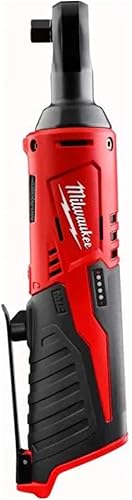
 Best for starting an M12 setup
Milwaukee M12 FUEL 3/8-inch High Speed Ratchet Kit
M12 ratchet vs M12 FUEL ratchet: what actually changes?
The exact model determines the useful differences: drive size, powered speed, features and included gear. Both standard M12 and M12 FUEL appear in this comparison, but FUEL alone isn't a reason to replace a tool that already suits your work.
The standard 2457-20 has a 3/8-inch drive, up to 35 ft-lb of torque and 250 RPM. Its variable-speed metal trigger lets you ease into movement instead of using full speed every time.
The 2567-22 FUEL kit also uses a 3/8-inch drive and has a 35 ft-lb torque figure. Its main buying advantage here is the package: 2 batteries, a charger and a case.
The brushless 2566-20 changes the socket setup to a 1/4-inch drive and delivers up to 40 ft-lb and 450 RPM. That higher maximum speed is useful for running free threads, provided the smaller drive suits your sockets.
How should you compare standard M12 and M12 FUEL ratchets?
Compare matching drives and complete setups before comparing names. The 2 larger-drive choices are the closer pair; the smaller-drive FUEL tool serves a different socket collection.
Write down the sockets you reach for most, whether you own compatible charging gear and the fasteners you repeatedly remove. Those 3 answers will narrow the choice faster than a torque figure alone.
Who should buy the standard Milwaukee 2457-20?
The 2457-20 suits existing M12 users doing routine 3/8-inch fastening. It makes sense for a home garage or maintenance bench where a cordless ratchet will take over repeated turns after a fastener is loose.
Choose it when your work involves removing several bolts, swapping parts and putting the same hardware back. The benefit comes from reducing repeated wrist movement across the job.
Its recessed forward and reverse switch helps prevent an accidental direction change. The onboard fuel gauge lets you check remaining charge, and the front LED helps illuminate the immediate work area.
Those controls are useful when you move between fasteners and reposition the tool often. You still need separate lighting when nearby parts cast shadows over the socket or threads.
Skip this bare tool if you need a complete battery setup and prefer to get it in one package. Also skip it if your everyday sockets use the smaller drive and adapters would become a constant part of the job.
For a closer look at this option, read the Milwaukee 2457-20 review.
Who should choose the FUEL 3/8-inch kit?
The FUEL kit suits someone starting an M12 setup who already knows a 3/8-inch ratchet fits the work. It brings the tool and charging gear together, rather than leaving you to arrange them separately.
A second battery lets you rotate packs, with one available while the other charges. That is useful for planned repair sessions, though actual runtime and charging time depend on the batteries and workload.
The case gives the equipment a place between jobs. Think about where it will live: a portable kit can suit a shared workspace, while a fixed bench may already have battery storage and charging space.
Don't choose this kit expecting a torque increase over the standard tool. Its shared torque figure makes package needs the clearer deciding factor between these 2 choices.
Skip the kit if you already have enough compatible batteries, a charger and storage. Our guide to cordless ratchet kits with batteries and chargers can help you weigh a complete package against a bare tool.
Who should choose the FUEL 2566-20?
The 2566-20 suits repeated work with 1/4-inch sockets, such as small brackets, covers and assembly hardware. Its higher maximum speed is most useful when you have several free-running fasteners to remove or install.
It has a variable-speed trigger, so you can slow the approach as a fastener seats. Full trigger travel is a choice for suitable work, not a setting you need to use throughout every task.
The brushless motor is another difference from the standard option described here. Milwaukee also includes REDLINK PLUS protection against overload and overheating.
Choose it as a tool that fits your smaller socket set, rather than treating it as a universal upgrade. A fast ratchet that needs an adapter for nearly every job is a poor match for that job.
Skip it if your work mainly uses 3/8-inch sockets or if you need included charging gear. Battery and charger are sold separately, so it makes the most sense when that part of your setup is already covered.
Does drive size matter more than the FUEL label?
Yes, match the drive to your everyday sockets first. That avoids adding unnecessary adapters and makes it easier to judge how the complete tool will fit around a fastener.
A drive size describes the connection between ratchet and socket. It does not tell you the socket's fastener size, and a smaller drive doesn't make every attached socket small enough for a cramped space.
Lay out the sockets used on your last few repairs. If most connect directly to one drive, that is a strong starting point unless you are building a separate set for a new kind of work.
Adapters can be useful for occasional tasks, but they add length between the ratchet and socket. That extra stack can remove the clearance you hoped to gain with a compact head.
Use our guide to choosing between 1/4, 3/8 and 1/2-inch ratchets if your socket collection is mixed.
How much should speed and torque affect your choice?
Speed matters most on loose threads; torque matters when the fastener resists turning. Neither number replaces a suitable breakaway tool or a torque wrench for final tightening.
Higher speed can save time when removing long bolts or handling rows of similar hardware. On a short screw that seats almost immediately, careful trigger control matters more than maximum RPM.
The 2566-20 has the higher stated speed of the 2 models with numerical speed figures here. The FUEL 3/8-inch kit is a high-speed model, but there is no numerical RPM figure here for a direct comparison.
Don't treat a ratchet's maximum torque as a selectable tightening setting. Thread condition, joint resistance and how you use the trigger can all affect where a fastener stops.
See how much torque a cordless ratchet has for help reading these figures. For a stubborn bolt, our cordless ratchet vs impact wrench comparison explains where each tool belongs.
Which ratchet will fit your work area?
Check the tool, socket, battery and hand clearance together. A head that reaches the bolt is only useful if you can seat the socket squarely and operate the trigger.
The 2457-20 and 2566-20 each have a 0.75-inch head profile. That shared measurement doesn't make their complete working shapes identical, especially once different sockets are attached.
The ratchet in the FUEL 3/8-inch kit is 11.1 inches long. Allow space for the handle and your grip, rather than judging fit only at the head.
Use a manual ratchet and the intended socket to map the approach before choosing a powered tool. Check nearby hoses, wiring, covers and anything that could stop the handle from moving into position.
Also consider the bolt's removal path. As a long bolt backs out, it can trap the socket and ratchet against nearby parts even when there was enough room at the start.
How should you set up an M12 ratchet for its first job?
Start with the correct socket, a charged compatible battery and a clear removal path. Read the tool's instructions before work, particularly its rules for manual force, battery handling and overload protection.
Remove the battery while inspecting the drive and fitting accessories. Check that the socket is undamaged, fully attached and the right size for the fastener.
Set the direction before placing the socket in a cramped area. Then hold the socket square to the fastener and keep fingers away from places where the handle could pinch them.
For removal, first decide whether the fastener needs loosening with a suitable manual tool. Once it turns freely, the cordless ratchet can handle the repeated rotations.
For installation, start the threads by hand and confirm they turn smoothly before using power. Ease off as the joint closes, then use a torque wrench when the repair calls for a specified final torque.
What mistakes should you avoid with either ratchet?
Avoid cross-threading, running against a hard stop and forcing a poor socket angle. These mistakes can damage the fastener or surrounding parts regardless of which model you choose.
Don't use motor power to pull a crooked bolt into place. If it resists early, stop, back it out and check alignment, thread condition and whether you have the correct hardware.
Don't keep holding the trigger when the ratchet stalls. Find the cause of resistance and change tools when necessary, rather than repeatedly asking the motor to overcome the same obstruction.
Keep the socket seated fully on the fastener. A partly engaged socket is more likely to slip or damage the head, especially when access encourages you to hold the ratchet at an angle.
Don't assume the handle can take any amount of extra force. Follow the model's instructions for manual use, and never add a pipe to gain leverage.
Finally, avoid buying around an occasional extreme job. Choose the ratchet for your repeated fastening work and use suitable equipment for unusually tight or damaged hardware.
How do you care for an M12 cordless ratchet?
Keep the tool clean, dry and free of packed debris, and follow its maintenance instructions. Remove the battery before cleaning, inspecting the drive or handling a stuck accessory.
Wipe away grime after work and keep battery contacts and cooling openings clear. Avoid soaking the tool or letting cleaning fluid enter the housing.
Inspect sockets, adapters and the drive connection for damage before the next repair. Replace worn accessories instead of compensating with more pressure or an awkward grip.
If the tool or battery becomes unusually hot, stop and allow it to cool. The 2457-20 has REDLINK protection, but protective electronics aren't a reason to keep forcing a stalled tool.
Store the ratchet where it won't collect moisture or loose metal debris. Follow the battery instructions for storage and charging, especially if the tool will sit unused between repair sessions.
Which M12 ratchet vs M12 FUEL ratchet should you choose?
For the M12 ratchet vs M12 FUEL ratchet decision, choose the tool that directly accepts your most-used sockets and leaves enough room to work. Then decide whether you need a bare tool or a complete battery setup.
- Choose the 2457-20 for routine 3/8-inch work when you already have compatible M12 gear and want its low-profile head, fuel gauge and lighting.
- Choose the FUEL 3/8-inch kit when you need the ratchet, batteries, charger and case together.
- Choose the 2566-20 when repeated smaller-fastener work calls for 1/4-inch sockets and faster free-thread rotation.
- Keep your current tool if it fits your sockets, reaches the fasteners and handles your workload without a clear gap.
Before ordering, identify one real job the new ratchet will improve and check the socket and handle clearance for it. That makes the decision more useful than choosing by the FUEL name alone.
For more model options, use our guide to choosing an M12 ratchet. If you're still deciding how often you'd use one, read what a cordless ratchet is used for.
For help building the rest of your setup around that choice, start with our cordless ratchet buying guide.
Frequently asked questions
Is the M12 FUEL ratchet more powerful than the regular M12?
Not every FUEL model has more torque than the regular M12; the standard 2457-20 and the 3/8-inch FUEL kit both offer 35 ft-lb, while the 1/4-inch 2566-20 delivers up to 40 ft-lb. Choose by the exact model, socket drive and job rather than assuming FUEL always means more turning force.
What is the difference between M12 FUEL and non-FUEL?
For these choices, the useful differences are drive size, speed, motor design and included gear; the standard 2457-20 is a 3/8-inch bare tool, while the FUEL options are a 3/8-inch kit and a brushless 1/4-inch bare tool. The FUEL name alone doesn't identify the package you need.
Does the Milwaukee M12 2457-20 include a battery?
No, the 2457-20 is a tool-only option with the battery sold separately, so plan for compatible M12 battery and charging gear. The 3/8-inch FUEL kit includes 2 batteries, a charger and a case; the 1/4-inch 2566-20 also requires a separate battery and charger.
Should I get a 1/4-inch or 3/8-inch cordless ratchet?
Choose the drive that matches your most-used sockets and fits the work area without extra adapters; a 1/4-inch setup often suits small fasteners, while 3/8-inch makes sense for an existing general repair socket set. Our drive-size comparison explains how to choose around your tools and access needs.
Can a cordless ratchet loosen tight or rusted bolts?
A cordless ratchet can remove fasteners within its working ability, but stubborn or rusted bolts may need a different tool for the initial breakaway. Don't keep powering a stalled ratchet; follow its instructions, loosen the fastener with suitable equipment, then use the ratchet to run it out.


