Milwaukee 2457-20 M12 Cordless Ratchet Review: Worth It? (November 2026)
The Milwaukee 2457-20 suits M12 battery owners who want a compact ratchet for routine automotive and maintenance work. Choose it for access and controlled fastening; choose an alternative below if you need more motor torque, an included kit or several socket drive sizes.
On this page (9 sections)
- Milwaukee 2457-20 review: who should buy it?
- What do its torque and speed mean for real jobs?
- Will the head and socket fit your engine bay?
- What battery setup should you choose?
- How does Milwaukee compare with DeWalt, AOBEN and Craftsman?
- How should you set up and use the ratchet?
- Which mistakes cause trouble with cordless ratchets?
- How do you care for the ratchet between jobs?
- Should you buy the Milwaukee 2457-20?
The Milwaukee 2457-20 is a good fit for M12 battery owners who want to speed up routine automotive and maintenance work in confined spaces. Buy it to reduce repeated hand ratcheting on accessible fasteners, especially after their initial resistance is broken.
Its strongest case is a garage that already has compatible batteries and sockets. If you're starting from scratch, compare the whole setup with a kit before choosing the bare tool.
Milwaukee 2457-20 review: who should buy it?
Choose the 2457-20 for routine fastener work where access and control matter more than maximum motor torque. Its 3/8-inch drive, output up to 35 ft-lb and speed up to 250 RPM suit spinning nuts and bolts through their threads.
Milwaukee 2457-20 M12 3/8-inch Ratchet: Best for M12-equipped garages
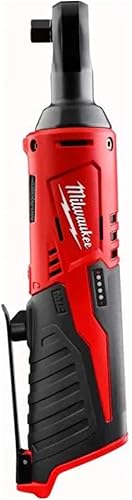
- 3/8-inch drive
- Up to 35 ft-lb torque
- Up to 250 RPM
- Low-profile head
- Tool only, battery sold separately
A compact choice for routine work around crowded engine bays, especially when you already own compatible M12 batteries. Its variable-speed metal trigger helps you control fastener movement.
Pros
- Low-profile head for confined work areas
- Variable-speed metal trigger
- Onboard fuel gauge and front LED
- Recessed forward and reverse switch
Cons
- Battery sold separately; a compatible charger is also needed
- Lower motor torque than the DeWalt alternative
The low-profile head helps with crowded work areas, while the variable-speed metal trigger lets you ease into movement. That combination makes sense for removing brackets, covers and similar parts when the socket can sit squarely on the fastener.
Milwaukee includes a front LED, a side fuel gauge and a recessed direction switch. These serve different needs: seeing the work, checking remaining charge and reducing accidental direction changes.
Milwaukee's REDLINK system manages communication between the tool and battery to help protect against excess power and overheating. You should still stop when a fastener won't move rather than hold the trigger against resistance.
Who should skip the Milwaukee 2457-20?
Skip this model if your main goal is freeing seized hardware or tightening fasteners to an exact value. Those jobs call for other tools and procedures, even if a cordless ratchet helps with part of the work.
It's also a less direct choice for someone with no M12 equipment and no socket collection. A bundle can reduce the number of separate items you need, while an existing battery platform may favor another brand.
For occasional repairs involving only a few easy fasteners, a manual ratchet may be enough. Our guide to whether cordless ratchets are worth it helps weigh the convenience against how often you'll use one.
What do its torque and speed mean for real jobs?
Treat motor torque as available turning force and speed as how quickly a free-moving fastener can travel. Neither figure tells you the correct tightening value for a particular bolt.
A powered ratchet earns its place when there's a long thread to run or little room to swing a handle repeatedly. It offers less benefit when setup takes longer than turning a single exposed fastener by hand.
For a stubborn bolt, use an appropriate manual tool to break it loose before switching to powered removal. Don't assume the cordless ratchet's housing or handle is suitable for added leverage; follow its manual for permitted manual use.
During installation, start the fastener by hand and use light trigger pressure as it turns. Stop before final tightening, then follow the equipment's required torque and tightening sequence.
If your work centers on heavily tightened hardware, read cordless ratchet vs impact wrench before choosing. The cordless ratchet buying guide explains how torque, speed, clearance and battery needs work together.
Will the head and socket fit your engine bay?
Check the complete tool-and-socket path, including the room needed to remove it after loosening the fastener. A head that fits at the start can become trapped as a bolt backs toward a nearby panel.
Begin with the shortest suitable socket that fully engages the fastener. A deep socket helps with protruding studs, but its extra length can use up the clearance you hoped to gain from a compact head.
An extension can move the ratchet body away from an obstruction when there's a straight path to the fastener. Keep the socket square and avoid pushing sideways to make a poor approach angle work.
Check room for your hand and the direction control too. The Milwaukee's recessed switch helps avoid accidental changes, but you still need access to reverse direction if a bolt approaches an obstruction.
The built-in light helps in a dim area, though a separate work light can reveal the surrounding removal path. Our guide to choosing a cordless ratchet covers reach and clearance in more detail.
What battery setup should you choose?
Buy the bare tool if you already have compatible M12 batteries and a charger available for it. If you don't, include both in your buying decision before comparing this Milwaukee with a complete kit.
Check compatibility by the battery system rather than the brand name alone. A battery from another Milwaukee platform isn't a substitute for the required M12 pack.
Battery shape matters when working around hoses, body panels and wiring. Consider the space around the handle as well as the head, and check the tool manual for approved battery options.
For occasional short jobs, charging before work may be enough. For longer sessions, a charged spare helps avoid stopping halfway through disassembly.
Don't choose a battery solely for capacity if it makes the tool awkward to position. Match the pack to your job length and available clearance.
How does Milwaukee compare with DeWalt, AOBEN and Craftsman?
Choose DeWalt for higher motor torque, AOBEN for an included starter kit, or Craftsman for mixed socket drives. Milwaukee remains the most direct choice here for an M12-equipped garage focused on routine fastening.
| Ratchet | Drive | Maximum motor torque | Battery setup |
|---|---|---|---|
| Milwaukee 2457-20 M12 3/8-inch Ratchet | 3/8 in | Up to 35 ft-lb | M12 battery sold separately |
| DeWalt DCF513B 20V ATOMIC 3/8-inch Ratchet | 3/8 in | Up to 70 ft-lb | 20V MAX battery and charger sold separately |
| AOBEN 3/8-inch 40 ft-lb Ratchet Kit | 3/8 in | Up to 40 ft-lb | Two batteries and charger included |
| Craftsman V20 Multi-Size Ratchet | 1/4, 3/8 and 1/2 in | Up to 40 ft-lb | Battery and charger sold separately |
DeWalt DCF513B: for existing 20V MAX users
The DeWalt suits buyers who already use its battery system and want more turning force for resistant fasteners. Its brushless motor, variable-speed trigger and trigger lock support that role without changing the need for controlled final tightening.
DeWalt says its glass-filled nylon housing helps resist damage from some oils and solvents. It also has an LED and low-profile head, so compare its working shape rather than assuming Milwaukee is the only access-focused option.
Skip it if your current M12 setup already covers your routine work and higher motor torque offers little benefit. Adding another battery system makes less sense when the tool solves no clear problem.
AOBEN kit: for a garage starting from scratch
AOBEN suits someone who needs the ratchet and supporting gear together. It includes 2 batteries, a charger, sockets, extension bars, an adapter and a carry case.
Check the included socket sizes against your actual repairs instead of choosing by the piece count. A broad assortment helps only when it contains the sizes and bit types your equipment uses.
Skip this bundle if you already have suitable sockets, extensions and a preferred battery system. Extra accessories can duplicate tools and take up storage space without improving access to your usual fasteners.
Craftsman V20: for several socket drive sizes
Craftsman suits buyers whose work moves between 1/4, 3/8 and 1/2-inch sockets. Its interchangeable anvils let you change drive sizes without relying on a separate drive adapter for each switch.
It has variable speed up to 300 RPM at no load, an in-line battery design and oil-resistant housing. The battery and charger are separate, so it is more appealing if you already use V20 tools.
Skip it if most of your sockets share one drive size and you rarely change sets. A larger anvil also doesn't increase the motor's torque or turn the ratchet into a heavy fastener removal tool.
For drive choice, see how 3/8-inch and 1/2-inch cordless ratchets differ. The DeWalt vs Milwaukee cordless ratchet comparison helps if your decision centers on those battery systems.
How should you set up and use the ratchet?
Start with a secure socket fit, correct direction and clear removal path. Read the tool manual before first use, and remove the battery before fitting accessories or clearing a jam.
- Prepare the work. Stabilize the equipment and follow its service procedure, including any required isolation from power or moving parts.
- Choose the socket. Match the fastener size exactly and seat it fully on the drive and fastener.
- Check direction. Confirm the selected direction before applying power, especially near an obstruction.
- Control movement. Keep the tool square, hold it securely and use light trigger pressure to begin.
- Finish correctly. Stop powered installation before final tightening and use the required torque procedure.
For removal, watch the bolt's travel as well as the head of the ratchet. Stop early if the tool begins to press against a nearby part or your hand loses clearance.
For installation, the bolt should turn easily by hand through its first threads. If it binds, back it out and inspect alignment rather than using motor force to pull it into place.
Which mistakes cause trouble with cordless ratchets?
The main mistakes are forcing resistance, starting threads under power and ignoring clearance. Avoiding these matters more than choosing the highest output figure.
- Holding the trigger on a stuck fastener: stop and identify why it won't turn before choosing another tool.
- Using the wrong socket: a loose fit can damage the fastener and make the repair harder.
- Driving a bolt home at full speed: slow down as parts meet so you can stop before excess tightening.
- Confusing motor output with final torque: the tool doesn't confirm a service torque value.
- Removing hardware without tracking it: keep bolts grouped by location, especially when lengths differ.
Also watch for hoses, wires and loose clothing around the rotating socket. Position the work light before powering the tool so you can keep attention on the fastener.
How do you care for the ratchet between jobs?
Keep the tool clean, dry and ready for its next use. Remove the battery before cleaning, then wipe away grime without pushing debris into the controls or head.
Follow the manual for approved cleaners and maintenance. Don't soak the tool or flood its head with solvent, and avoid adding lubricant unless the instructions call for it.
Inspect the socket drive, direction switch and trigger before putting the tool away. Stop using it if an accessory won't stay secure or a control no longer works normally.
Store batteries and the charger as their instructions require. Keep sockets organized by size so the next repair starts with a correct fit instead of a rushed guess.
Should you buy the Milwaukee 2457-20?
Buy the Milwaukee 2457-20 if you have M12 equipment and regularly run accessible fasteners in crowded automotive or maintenance spaces. Confirm that your sockets fit the work area and that the jobs justify powered ratcheting.
Choose DeWalt when higher motor torque and existing 20V MAX batteries drive the decision. Choose AOBEN when you need a starter bundle, or Craftsman when changing socket drive sizes is a regular part of your work.
If Milwaukee is your choice, compare which M12 ratchet you should buy and M12 vs M12 FUEL ratchets before ordering. The broader cordless ratchet guide can help you check the rest of your setup.
Frequently asked questions
How much torque does the Milwaukee 2457-20 have?
The Milwaukee 2457-20 delivers up to 35 ft-lb of motor torque, with speed up to 250 RPM. Use it for routine fastener removal and installation after checking access and thread condition.
Its output figure is not a selectable tightening setting, so finish specified torque with a torque wrench.
Does the Milwaukee 2457-20 come with a battery?
No. The Milwaukee 2457-20 is a tool-only model, and its compatible M12 battery is sold separately.
You'll also need a compatible charger, so count both when building a new setup.
Existing M12 battery owners can choose the bare tool without adding another battery system.
Is the Milwaukee 2457-20 good for tight spaces?
Yes, its low-profile head makes it a useful choice for confined automotive and maintenance work. Check clearance with the socket attached, since socket depth and nearby parts affect access.
Also leave room to operate the direction switch and withdraw the tool as a bolt backs out.
What is the difference between the Milwaukee 2457-20 and DeWalt DCF513B?
The Milwaukee uses M12 batteries and favors buyers seeking a compact ratchet for routine work. The DeWalt uses 20V MAX batteries, has a brushless motor and offers a higher torque ceiling.
Choose by your existing batteries, the available working space and the resistance your usual fasteners present.


