DeWalt vs Milwaukee Cordless Ratchet: Which Is Better? (November 2026)
The DeWalt vs Milwaukee ratchet choice favors Milwaukee for tight access, DeWalt ATOMIC for higher powered torque with 3/8-inch sockets, and DeWalt XR for mixed drive sizes. Choose around your usual fasteners, working room and compatible batteries.
On this page (11 sections)
- DeWalt vs Milwaukee ratchet: which should you choose?
- How much do torque and speed matter?
- Who should buy the Milwaukee 2457-20?
- Who should buy the DeWalt ATOMIC DCF513B?
- Who should buy the DeWalt XR DCF510B?
- How do you check whether a ratchet will fit?
- Does an interchangeable drive matter for your sockets?
- What battery setup should you plan for?
- How should you set up and use a cordless ratchet?
- Which mistakes shorten tool life or damage fasteners?
- Which DeWalt vs Milwaukee ratchet belongs in your shop?
The DeWalt vs Milwaukee ratchet choice favors Milwaukee for tight access, DeWalt ATOMIC for higher powered torque with 3/8-inch sockets, and DeWalt XR for switching between socket drive sizes. Start with the jobs you repeat, then check which batteries you already have.
This comparison covers the Milwaukee 2457-20, DeWalt DCF513B ATOMIC and DeWalt DCF510B XR. It doesn't settle every ratchet choice across either brand's range.
A cordless ratchet earns its place by turning fasteners where a hand ratchet needs repeated handle swings. The right model saves that motion while leaving enough room to place the socket, hold the tool and remove the bolt.
 Best for DeWalt garage owners
DeWalt DCF513B 20V ATOMIC 3/8-inch Ratchet
DeWalt vs Milwaukee ratchet: which should you choose?
Choose the Milwaukee for restricted access, the ATOMIC for DeWalt users with one main socket drive size, or the XR for work that regularly needs both drives. Higher torque matters only after the tool fits the job.
Use these buyer patterns to narrow the choice:
- You remove covers, brackets and similar hardware in crowded areas: start with the Milwaukee.
- You already use DeWalt batteries and mostly reach for 3/8-inch sockets: start with the ATOMIC.
- You regularly switch between 3/8- and 1/2-inch sockets: consider the XR.
- Your main problem is seized bolts or tight wheel fasteners: reconsider the tool type before choosing a ratchet.
Battery ownership is a useful tie-breaker, but access comes first. A compatible pack saves you from adding another charging setup, while an awkward tool still makes every cramped job harder.
Our complete cordless ratchet guide explains the wider buying choices. For this comparison, focus on socket fit, working room and the kind of powered help you need.
How much do torque and speed matter?
The DeWalt models offer higher maximum torque, while speed matters most when running a fastener through several turns. Neither figure tells you whether the tool will reach the bolt or safely finish the repair.
| Ratchet | Maximum torque | Speed | Drive |
|---|---|---|---|
| Milwaukee 2457-20 | 35 ft-lb | 250 RPM | 3/8 in |
| DeWalt DCF513B ATOMIC | 70 ft-lb | Variable-speed trigger | 3/8 in |
| DeWalt DCF510B XR | 75 ft-lb | 0–300 RPM, no load | Interchangeable 3/8 and 1/2 in |
Higher powered torque gives the DeWalt options more capacity to keep turning against resistance. It doesn't guarantee removal of a rusted bolt, and the small torque gap between the DeWalt models is a weak reason to choose the XR by itself.
The XR's speed is a no-load figure, so don't treat the numbers as a measured comparison of repair speed. Thread condition, resistance and how carefully you control the trigger all affect progress.
All 3 have variable-speed triggers. Slow control is especially useful when starting a fastener or approaching a seated part, where full speed can turn a small mistake into damaged threads.
Can DeWalt or Milwaukee ratchet torque replace a breaker bar?
Keep a suitable loosening tool available for fasteners that resist powered removal. Don't add a pipe or apply extra leverage to a cordless ratchet unless its manual expressly allows that use.
Once the fastener turns freely, the powered ratchet can handle the repeated rotations. During installation, stop before final tightening and use a torque wrench when the repair procedure gives a torque value.
Our guide to cordless ratchet torque explains this distinction. If breaking tight fasteners loose is your main goal, read cordless ratchet vs impact wrench before buying.
Who should buy the Milwaukee 2457-20?
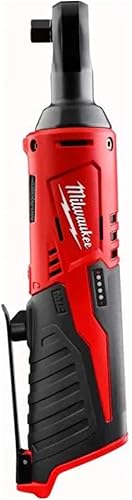
The Milwaukee suits routine work in crowded spaces, especially if you already use M12 batteries. It's shorter and lighter than both DeWalt options here, which makes it the first model to consider when positioning the tool is the hard part.
Its low-profile head helps with access around nearby parts. The recessed direction switch also helps prevent an unintended direction change when the back of the head brushes against something.
The front LED helps you see the fastener, while the side fuel gauge lets you check charge before starting. That gauge is useful when you want to finish a group of fasteners without stopping to change packs.
Choose it for repeated removal and installation after the initial loosening step. It makes particular sense if your socket set and usual work already center on its fixed drive size.
Skip it if higher powered torque is your priority and the larger DeWalt tools fit your workspace. Also look elsewhere if you regularly need direct use of 1/2-inch sockets rather than adding an adapter.
The Milwaukee 2457-20 review gives a closer look at this model. For other choices within the same battery family, see which M12 ratchet to buy.
Who should buy the DeWalt ATOMIC DCF513B?
The DCF513B suits DeWalt users who mainly use 3/8-inch sockets and want more powered torque than the Milwaukee offers. It avoids paying attention to interchangeable anvils you may rarely need.
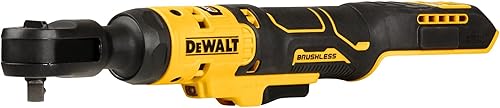
The ATOMIC measures 15.79 inches long and weighs 2.6 lb. Despite its compact design and low-profile head, it's the longest tool in this comparison, so don't use the ATOMIC name as a shortcut for checking fit.
Its brushless motor, variable-speed trigger and trigger lock support controlled fastening work. The LED helps illuminate the area, and DeWalt says the glass-filled nylon housing helps resist damage from some automotive oils and solvents.
Choose this model when you have room for its body and battery and want to stay with your existing DeWalt setup. It's also the lighter DeWalt option here for jobs where you hold the tool in position for repeated fasteners.
Skip it if cramped access dominates your work, or if you regularly switch to larger-drive sockets. Those needs point toward the Milwaukee or XR, respectively.
Who should buy the DeWalt XR DCF510B?
The DCF510B suits buyers with mixed socket sets, because its included interchangeable anvils accept both drive sizes directly. That feature is the clearest reason to choose it over the ATOMIC.
The XR measures 15 inches long and weighs 3.1 lb. It's slightly shorter than the ATOMIC but heavier, so the choice involves more than which body has the smaller length measurement.
Its sealed head and glass-filled nylon housing are designed to help protect against automotive oils and solvents. Those features suit a repair environment, but they don't make the tool waterproof or remove the need for cleaning.
Choose the XR if you repeatedly change socket drive sizes during maintenance and have enough room for the tool. Direct socket attachment can also avoid the extra stack height that a drive adapter adds.
Skip it if almost all your sockets use one drive size and lower weight matters more. The modest torque increase over the ATOMIC won't justify the heavier tool for every buyer.
Our DeWalt ATOMIC vs XR comparison can help settle that narrower choice.
How do you check whether a ratchet will fit?
Check the whole tool-and-socket setup, including your hand and the attached battery. A head that reaches a bolt is only useful if you can hold the tool square and operate its controls.
Start with a repair you often repeat. Look at the route into the work area, the space beside the fastener and any obstruction behind the handle.
Socket depth matters too. A deep socket may clear a protruding stud but use space you need to keep the ratchet aligned, while an extension changes where the head and handle sit.
Also allow room for the fastener to move outward. A bolt can back the ratchet into a nearby panel before it comes free, leaving too little space to remove the socket or reach the direction switch.
Don't plan around working at an angle to make the tool fit. If you can't seat the socket fully and keep it aligned, change the setup or use a suitable hand tool.
For more repair-specific choices, our cordless ratchets for automotive work guide focuses on matching the tool to the task.
Does an interchangeable drive matter for your sockets?
An interchangeable drive matters when you use both socket sizes often. If your usual repairs stay within one socket set, a fixed-drive tool is a sensible choice.
Socket drive size describes the square connection to the tool, not the size of the nut or bolt. Check the connection on the back of your sockets rather than choosing from the fastener size alone.
An adapter can connect different drive sizes, but it adds another part and extra distance between the head and socket. That can undo the access benefit you wanted from a cordless ratchet.
A larger drive also doesn't turn a ratchet into a tool for every large fastener. The repair procedure, required torque and available clearance still control the choice.
Our cordless ratchet drive-size guide explains when each connection size makes sense.
What battery setup should you plan for?
Plan for a compatible battery and charger, because these are bare tools. The Milwaukee uses M12 batteries, while both DeWalt models use 20V MAX batteries and exclude the battery and charger.
If you already own compatible packs, check that your usual pack leaves room around the handle. Battery shape affects placement, so consider the assembled tool rather than the bare body alone.
Starting from scratch means choosing a charging setup as well as a ratchet. Don't assume packs from different brands fit each other, or that a battery from another tool family will work because its voltage sounds similar.
Milwaukee's REDLINK electronics communicate with the battery to help protect against excess power and overheating. Protection electronics are a backup, so release the trigger when the tool stalls rather than holding it against a stuck fastener.
For repeated work, keep charging access convenient and follow the battery instructions for storage. A ready pack is more useful than extra features on a tool you can't power when a repair begins.
How should you set up and use a cordless ratchet?
Start with the correct socket, a seated battery and a clear removal path. Check direction before putting the socket on the fastener, then use light trigger pressure until you're sure the setup is right.
A simple sequence helps:
- Prepare the work area. Secure the vehicle or equipment as the repair requires and move loose wires or hoses away from the tool.
- Inspect the socket. Use the correct size and replace cracked or badly worn sockets.
- Loosen stubborn fasteners appropriately. Use a suitable tool before asking the powered ratchet to run them out.
- Keep the socket square. Hold the tool so it stays fully engaged as the fastener moves.
- Start installation by hand. Confirm the threads engage freely before using power.
- Finish to the repair specification. Use the required tightening sequence and torque wrench where specified.
Support your hand where it won't become trapped if the tool reacts against resistance. Slow down near nearby parts, and reposition before the handle or your fingers run out of clearance.
Both DeWalt models have trigger locks. Engage them when appropriate, and remove the battery before changing anvils, cleaning or making adjustments as directed by the manual.
Which mistakes shorten tool life or damage fasteners?
The most common avoidable mistakes are forcing a stalled tool, starting threads under power and ignoring clearance. Better technique protects both the repair and the ratchet.
Don't use motor resistance as a signal that a bolt has reached the correct tightness. Different threads and joint conditions change resistance, so that method can't replace a specified torque value.
Avoid repeatedly squeezing the trigger against a seized fastener. Stop, inspect the problem and choose the loosening method the repair calls for.
After work, remove the battery and wipe away oil and dirt with a cloth and an approved cleaning method. Keep debris out of the drive connection, controls and battery contacts.
Don't soak the tool or assume solvent-resistant housing allows any cleaner. Follow the manual for lubrication and cleaning, and inspect sockets and interchangeable parts before the next job.
Which DeWalt vs Milwaukee ratchet belongs in your shop?
Settle the DeWalt vs Milwaukee ratchet decision with your most common repair, rather than the toughest bolt you might encounter once. Choose the tool that fits that work comfortably and accepts the sockets you reach for most.
Pick the Milwaukee when access and lower weight lead your priorities. Choose the ATOMIC when you want higher powered torque, already use DeWalt batteries and mainly work with one drive size.
Choose the XR when changing between socket drive sizes is a regular part of the job. If that feature would sit unused, its extra weight brings little benefit to your routine.
Before ordering, identify one repeated task, the socket it needs and the space available around it. If you're still deciding whether powered ratcheting will save enough effort, read are cordless ratchets worth it?.
Frequently asked questions
Is DeWalt or Milwaukee better for a cordless ratchet?
Milwaukee's 2457-20 suits buyers who put tight access and lower weight first. Choose DeWalt's DCF513B for higher powered torque with 3/8-inch sockets, or the DCF510B for interchangeable drive sizes; these are specific model choices, so use your working space and compatible batteries to settle the decision.
Which has more torque, the DeWalt or Milwaukee ratchet?
The DeWalt DCF510B has the highest maximum torque at 75 ft-lb, followed by the DCF513B at 70 ft-lb and Milwaukee 2457-20 at 35 ft-lb. Those figures describe powered output, not a guaranteed ability to free seized fasteners or tighten a bolt to its required final torque.
Which cordless ratchet is shortest?
The Milwaukee 2457-20 is the shortest of these 3 options. The DeWalt DCF510B measures 15 inches, while the DCF513B measures 15.79 inches; before choosing, check the entire working space, including room for your hand, the socket, the attached battery and the fastener as it backs out.
Do these ratchets include batteries?
No, all 3 are tool-only ratchets with batteries sold separately, and both DeWalt models also exclude the charger. The Milwaukee uses M12 batteries, while the DeWalt models use 20V MAX batteries; make sure you have a compatible pack and charging setup before buying a bare tool.
Can a cordless ratchet loosen every bolt?
No, a cordless ratchet won't loosen every bolt. Use a suitable breaker bar or other tool when the repair procedure calls for more loosening force, then use the powered ratchet to run the fastener out; finish installation with a torque wrench whenever a specified final torque is required.


