DeWalt ATOMIC DCF513B Cordless Ratchet Review: Worth It? (November 2026)
The DeWalt DCF513 is a strong fit for DeWalt battery owners doing routine 3/8-inch fastening. Choose the DCF513B bare tool for running accessible nuts and bolts, with a separate torque wrench for final tightening to a service specification.
On this page (9 sections)
- What does the DeWalt DCF513 offer?
- Which DCF513B specs affect the buying decision?
- Is its torque enough for automotive work?
- Which alternative should you choose instead?
- What should you check before buying the bare tool?
- How should you set up and use the DCF513B?
- Which mistakes cause trouble with powered ratchets?
- How should you clean and store it?
- Should you buy the DeWalt DCF513?
The DeWalt DCF513 suits DeWalt battery owners who want to speed up routine 3/8-inch fastening. The DCF513B pairs a brushless motor with a low-profile head, making it worth considering for automotive and equipment work where repeated manual ratcheting gets awkward.
Buy it to run nuts and bolts once they can turn freely, then follow the service procedure for final tightening. Choose a different tool if your main problem is seized hardware, frequent drive-size changes or a battery system you already own from another brand.
What does the DeWalt DCF513 offer?
The DCF513B offers powered fastening with controlled speed and a compact head. Its main value is reducing repeated handle swings when removing or installing several fasteners.
DeWalt DCF513B 20V ATOMIC 3/8-inch Ratchet: Best for DeWalt garage owners
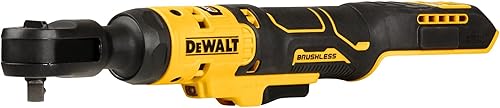
- 3/8-inch drive
- Up to 70 ft-lb torque
- Brushless motor
- Low-profile head
A dedicated ratchet for DeWalt battery owners who mainly use 3/8-inch sockets. Its low-profile head helps reach fasteners where repeated handle swings are awkward.
Pros
- Works with DeWalt 20V MAX batteries
- Variable-speed trigger and trigger lock
- Onboard LED work light
- Housing designed to resist some oils and solvents
Cons
- Battery and charger sold separately
- Fixed 3/8-inch drive
The variable-speed trigger helps you start slowly and increase speed as the fastener turns freely. An onboard LED lights the work area, while the trigger lock helps prevent accidental activation when applied.
DeWalt uses glass-filled nylon for the housing to help resist damage from some oils and solvents. That protection suits a garage setting, but it isn't a reason to leave chemical spills on the tool.
Who should buy the DeWalt DCF513?
Choose the DCF513 if most of your regular sockets have 3/8-inch drives and you already have compatible DeWalt batteries. It's a sensible addition for repeated disassembly and reassembly work.
For example, several accessible bolts on a cover or bracket can involve many manual ratchet strokes. A powered ratchet can handle the turning stage while you concentrate on socket alignment and keeping track of removed hardware.
Skip it if you only remove a few easy bolts occasionally and a manual ratchet already does the job comfortably. Our guide to whether cordless ratchets are worth it can help you judge how often you'd use one.
Also look elsewhere if you regularly alternate between socket drive sizes. The DeWalt ATOMIC vs XR ratchet comparison explains the choice between a dedicated drive and interchangeable anvils.
Which DCF513B specs affect the buying decision?
Focus on drive size, working clearance and battery compatibility before maximum torque. A ratchet only helps if your socket fits and the assembled tool can reach the fastener.
| Detail | DeWalt DCF513B |
|---|---|
| Drive | Fixed 3/8 in |
| Maximum torque | Up to 70 ft-lb |
| Motor | Brushless |
| Tool weight | 2.6 lb |
| Length | 15.79 in |
| Battery platform | DeWalt 20V MAX |
| Included power equipment | Battery and charger sold separately |
Check the whole working space, not just the gap above the bolt. You need room for the head, socket, handle, attached battery and your hand.
Socket depth matters too. A deep socket may reach a recessed fastener but make the assembled tool too tall beneath an obstruction.
Use the shortest socket that fully engages the fastener and clears nearby parts. Extensions and adapters can solve access problems, but each added connection takes space and can make alignment harder to control.
The tool's weight is another reason to consider your working position. Holding a ratchet overhead for repeated fastening is different from using it on a bench with your arm supported.
Is its torque enough for automotive work?
The DCF513B's up-to-70 ft-lb output is useful for powered fastening, but it doesn't make the tool a solution for every stuck bolt. Fastener condition, thread damage and corrosion all affect removal.
A cordless ratchet is most useful when it can keep a fastener turning without repeated manual strokes. If a bolt won't move, stop and choose an appropriate removal method rather than holding the trigger against it.
A breaker bar or suitable impact wrench may belong in the same tool kit for stubborn hardware. Read our cordless ratchet vs impact wrench guide if breaking bolts loose is your main reason for shopping.
Don't interpret maximum output as an automatic tightening limit. The trigger controls speed, and it isn't a calibrated setting for a bolt's required final torque.
For background on comparing these figures, see how much torque a cordless ratchet has. Start with the service requirements for your work, then choose the tools for each stage.
Which alternative should you choose instead?
Choose an alternative when your sockets or existing batteries favor it. The useful differences here are drive flexibility, tool weight and battery platform.
| Model | Socket connection | Main reason to choose it |
|---|---|---|
| DCF513B | Fixed 3/8 in | Dedicated tool for routine 3/8-inch work |
| DCF510B | Interchangeable 3/8 and 1/2 in | Regular use of both socket sets |
| DCF512B | Fixed 1/2 in | Direct fit for a 1/2-inch socket collection |
| Milwaukee 2457-20 | Fixed 3/8 in | Addition to an existing M12 setup |
Socket drive size and fastener size are separate measurements. A 3/8-inch drive socket can fit many different nut and bolt sizes, so check the square connection on your sockets before ordering.
The cordless ratchet drive-size guide explains that choice in more detail.
Choose the DCF510B for regular drive changes
The DCF510B makes sense when both socket sets get regular use. It includes interchangeable 3/8-inch and 1/2-inch anvils, so you can change the tool's drive rather than rely on an adapter.
Its brushless motor delivers up to 75 ft-lb and 0–300 no-load RPM. The sealed head and housing are designed to help protect against automotive oils and solvents.
At 3.1 lb, it is heavier than the main pick. Choose it for the anvil flexibility rather than the small increase in maximum output, and skip it if one socket set handles almost everything you do.
Choose the DCF512B for a dedicated larger drive
The DCF512B suits buyers who mainly reach for 1/2-inch drive sockets. It offers the ATOMIC format with a direct connection to that socket collection.
Its maximum torque matches the DCF513B, so the larger square drive doesn't mean more powered turning force. The buying reason is a better match to your tools.
Skip it if your everyday sockets are mostly 3/8-inch drive. Buying the correct drive at the start avoids making an adapter part of every job.
Choose the Milwaukee 2457-20 for an M12 setup
The Milwaukee 2457-20 is the practical alternative if you already use M12 batteries. It has a low-profile head, variable-speed trigger, LED and onboard fuel gauge.
Its maximum output is 35 ft-lb, with a speed of 250 RPM. That makes it a choice for buyers who prioritize their existing platform and routine fastener turning over the higher output of these DeWalt options.
Skip it if you're choosing specifically for the DeWalt battery system or want the higher maximum output shown here. Compare DeWalt and Milwaukee cordless ratchets before adding a second battery platform.
What should you check before buying the bare tool?
Confirm that you have a compatible battery, charger and socket set. The DCF513B works with all DeWalt 20V MAX batteries and chargers, but neither power item comes with it.
An existing battery can make the bare tool a straightforward addition. Consider whether that battery is usually tied up in another tool when you need the ratchet.
If you're starting a new battery system, plan the whole setup rather than comparing tool bodies alone. You'll need a way to charge the battery and enough available charge to finish the work you expect to do.
Also check the jobs you do most often. A dedicated ratchet earns its place through repeated use, so prioritize your usual access problems over a rare task that may need another tool anyway.
How should you set up and use the DCF513B?
Start with the correct socket, a clear work area and a slow trigger input. Follow the tool manual and the vehicle or equipment service procedure for the job.
Remove the battery before fitting accessories or clearing a jam. Check that the socket is undamaged and securely attached before restoring power.
For installation, start the fastener by hand for several turns. If it won't thread freely, back it out and correct the alignment before using the motor.
Keep the socket square to the fastener and support the tool so it doesn't lean against nearby parts. Plan where your fingers will go if the handle reacts when the fastener seats.
Begin slowly, then increase speed only while the fastener turns freely. Ease off as parts come together so you retain control of the final approach.
Before backing out a long bolt, check where the head and handle will move as the bolt rises. A tool that fits at the start can become trapped between the fastener and a nearby panel.
Use the LED to help locate the fastener, then add workshop lighting if shadows hide the threads or surrounding parts. Seeing the socket clearly makes it easier to keep it fully engaged.
Which mistakes cause trouble with powered ratchets?
The main mistakes are forcing stuck hardware, starting threads under power and ignoring clearance. Each can turn a time-saving tool into extra repair work.
Don't keep applying power when a fastener stops moving. Release the trigger, check the situation and choose the right tool or removal procedure.
Don't use powered speed to overcome resistance on a newly started bolt. Resistance may mean crossed threads, dirt or the wrong fastener, all of which need attention before you continue.
Don't assume the motor stopping means the bolt has reached its required final torque. Finish critical tightening with the specified method and a suitable torque wrench.
Avoid using a long extension when a shorter arrangement reaches comfortably. Extra reach can help access, but keeping the tool aligned becomes more important as the connection gets longer.
Finally, don't carry the tool with your finger resting on the trigger. Apply the trigger lock when appropriate, and remove the battery before adjustments or cleaning.
How should you clean and store it?
Keep the ratchet clean, dry and free of chemical residue. DeWalt's housing protection helps with some garage chemicals, but ordinary care still matters.
Remove the battery before cleaning. Wipe away oil and dirt with a cloth, and follow the manual for approved cleaning methods.
Don't soak the tool or spray cleaner into openings. Clear debris around the drive and check sockets for cracks, wear or a loose fit before the next job.
Stop using the ratchet if the trigger, lock or drive behaves unexpectedly. Have the problem addressed before putting it back into regular use.
Store it where the trigger won't be pressed by other tools. Keep the battery and charger according to their own care instructions, and put sockets back where you can identify the correct size quickly.
Should you buy the DeWalt DCF513?
Buy the DeWalt DCF513 for frequent 3/8-inch fastening in an existing DeWalt setup. Before ordering, check one representative job for socket fit, battery clearance and room to withdraw the tool.
Choose the DCF510B if drive changes are routine, or the DCF512B if your socket collection favors a dedicated larger drive. Choose the Milwaukee 2457-20 when staying with M12 matters more than these DeWalt options' higher maximum output.
Keep a manual removal tool and a torque wrench available for the stages a powered ratchet doesn't replace. Our complete cordless ratchet buying guide can help you plan that tool kit around the work you actually do.
Frequently asked questions
How much torque does the DeWalt DCF513B have?
The DeWalt DCF513B delivers up to 70 ft-lb of torque; that figure describes its maximum output, not a tightening setting for every bolt. Follow the vehicle or equipment service procedure, and use a suitable torque wrench whenever a fastener needs a specified final torque.
Does the DeWalt DCF513B include a battery?
No, the DCF513B comes without a battery or charger; it works with all DeWalt 20V MAX batteries and chargers, making the bare tool a useful addition to that system. If you're starting from scratch, include both items in your buying plan before choosing between battery platforms.
What drive size is the DCF513B?
The DCF513B has a fixed 3/8-inch square drive for matching sockets; choose the DCF512B if your regular sockets use a 1/2-inch drive, or the DCF510B if you need both sizes. Socket drive size describes the connection to the tool, not the size of the fastener.
Is the DCF513B the same as the DeWalt DCF510B?
No, the DCF513B is a dedicated 3/8-inch ATOMIC ratchet, while the DCF510B is an XR ratchet with interchangeable 3/8-inch and 1/2-inch anvils. Choose the DCF513B for a single-drive setup or the DCF510B when switching between socket sets is a regular part of your work.


