DeWalt ATOMIC Ratchet vs XR: Which Is Better? (November 2026)
For DeWalt ATOMIC ratchet vs XR, choose ATOMIC if most jobs use one socket drive size. Choose the XR DCF510B if you regularly use both 3/8-inch and 1/2-inch sockets and want interchangeable anvils in one tool.
On this page (10 sections)
- DeWalt ATOMIC ratchet vs XR: which suits your work?
- Who should buy each DeWalt model, and who should skip it?
- How much should torque and speed affect your choice?
- Which drive size matches your sockets?
- Which ratchet fits tight spaces and longer jobs?
- What should you have ready before the first job?
- How do you use either ratchet with better control?
- What controls and care features matter in a workshop?
- Which buying mistakes are easiest to avoid?
- DeWalt ATOMIC ratchet vs XR: make the final decision
For DeWalt ATOMIC ratchet vs XR, choose ATOMIC when your regular work uses one socket drive size; choose XR when you often switch between two. Socket fit and access matter more than the small difference in maximum torque.
The DCF513B ATOMIC has a dedicated 3/8-inch drive, while the DCF512B ATOMIC has a dedicated 1/2-inch drive. The DCF510B XR includes interchangeable anvils for both sizes.
Start with the sockets you already reach for, then consider the space around your usual fasteners. A tool that fits those jobs is more useful than extra features you rarely need.
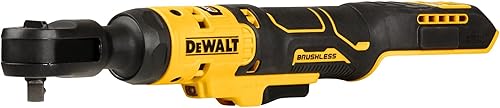 Best for routine car maintenance
DeWalt DCF513B 20V ATOMIC 3/8-inch Ratchet
 Best for mixed socket sets
DeWalt DCF510B 20V XR 3/8 and 1/2-inch Ratchet
DeWalt ATOMIC ratchet vs XR: which suits your work?
ATOMIC suits a consistent socket setup; XR suits a mixed one. Count how often you change drive sizes during a normal repair, rather than choosing by the ATOMIC or XR name alone.
For someone removing covers and brackets with the same socket set, a dedicated drive keeps the workflow simple. You fit the socket and get on with the job.
The XR makes more sense when one repair moves between different socket collections. Its interchangeable anvils let you use either collection directly, without keeping two powered ratchets nearby.
DeWalt ATOMIC vs XR: buy for your regular jobs
Buy for the work you repeat, not the largest fastener you might encounter once. A cordless ratchet earns its place by cutting repeated hand turns after a fastener starts moving.
Think through your last few repairs: which sockets did you use, where did a hand ratchet feel slow, and where was access awkward? Those answers reveal whether you need a dedicated tool, interchangeable drives or a different tool category.
If most of your effort goes into freeing seized fasteners, start with the cordless ratchet vs impact wrench guide. More drive options won't solve a mismatch between the tool and the job.
Who should buy each DeWalt model, and who should skip it?
Choose the DCF513B for a 3/8-inch routine, the XR for mixed drives, and the DCF512B for a 1/2-inch routine. Each has a clear buyer, so there's little reason to choose a drive size that adds adapters to most jobs.
DCF513B ATOMIC: for regular maintenance with smaller socket sets
The DCF513B suits a home mechanic whose usual maintenance sockets use its drive size. Its low-profile head is also worth considering for work around brackets, hoses and nearby parts.
Choose it when your socket collection already covers your common fasteners without changing drive sizes. Our DeWalt ATOMIC DCF513B review covers that model in more detail.
Skip it if your most-used sockets belong to a different drive system. Buying a dedicated ratchet and immediately adding an adapter to nearly every socket weakens the reason for choosing it.
DCF510B XR: for repairs that use both socket collections
The XR suits someone who regularly brings both socket sets to the same repair. The package includes both anvils, so the drive changes are part of the tool's intended setup.
It also suits a shared workspace where different jobs call for different sockets. Keep the spare anvil in a fixed storage spot so it stays available when the next task needs it.
Skip the XR if you rarely change drive sizes and want the lighter option. Interchangeability has little practical value when the spare anvil stays in a drawer.
DCF512B ATOMIC: for an established 1/2-inch setup
The DCF512B suits someone who already works mainly from a 1/2-inch socket collection. It gives those sockets a direct connection without buying a second drive system.
Skip it if you're choosing it only because a larger square drive sounds more powerful. Its maximum motor torque matches the other ATOMIC model here.
Also skip it if most of your work involves small fasteners in cramped areas and your matching sockets are bulky. The complete socket and tool assembly must fit, not just the ratchet head.
How much should torque and speed affect your choice?
Treat torque as a capability limit, not the main buying rule. DeWalt specifies up to 75 ft-lb for the XR and up to 70 ft-lb for both ATOMIC models.
That 5 ft-lb gap is a modest difference. It isn't a strong reason to abandon the drive size or access that suits your work.
The XR has a 0–300 RPM no-load speed. No-load speed describes rotation without resistance, so it isn't a promise of the same speed while moving a fastener.
All 3 have variable speed triggers, which help you approach a fastener gently and increase speed once it turns freely. For everyday use, controlled starts matter more than running at full speed throughout a job.
A powered ratchet also doesn't set a chosen final tightening value. Use the repair procedure and a suitable torque wrench wherever a fastener has a required torque.
Our guide to how much torque a cordless ratchet has explains why maximum output and final fastening torque serve different purposes.
Which drive size matches your sockets?
Match the ratchet's square drive to your working sockets before comparing other features. The size marked on a socket for the nut or bolt isn't the same as its drive size.
For example, sockets with the same fastener opening can have different square drive openings. Check the tool end of your sockets instead of assuming the marked size tells you which ratchet fits.
Lay out the sockets from your most common repair. If they mostly share one drive, a dedicated model is an easy choice; if they split between two drives, the XR becomes more useful.
Adapters can help occasionally, but they add length between the head and fastener. In a narrow gap, that extra stack can prevent the socket from sitting squarely.
Don't replace a useful socket collection just to suit a ratchet you chose first. The cordless ratchet drive size guide explains the tradeoffs between common drive sizes.
Which ratchet fits tight spaces and longer jobs?
Check head clearance, socket depth and battery space together. Overall tool length alone can't show whether a ratchet will reach a fastener.
The DCF513B measures 15.79 inches and weighs 2.6 lb, while the XR measures 15 inches and weighs 3.1 lb. The DCF512B weighs 2.63 lb.
Both ATOMIC models have low-profile heads designed for restricted locations. The XR has a sealed head and a forward/reverse switch, but those features don't tell you which head fits a particular gap.
For a recessed bolt, consider the approach angle and whether a deep socket leaves room for the head. For an exposed bolt near a panel, check whether the body and battery can clear the surrounding parts.
Weight matters when you hold a tool above shoulder level or reach across an engine bay. Consider the complete working setup with its battery and socket when judging how manageable it will be.
Before removing a long bolt, leave enough room to withdraw the tool as the bolt backs out. A ratchet that fits at the start can become trapped between the rising bolt and a nearby surface.
What should you have ready before the first job?
Have a compatible battery, charger, matching sockets and a manual backup ready. All 3 models are bare tools, with batteries and chargers sold separately.
Both ATOMIC models work with all DEWALT 20V MAX batteries and chargers. If you're starting without a battery system, include those parts in your buying decision rather than treating the ratchet alone as the complete setup.
Keep a hand ratchet or suitable breaker bar nearby for fasteners that need initial loosening. Add a torque wrench when the repair calls for a specified final torque.
Prepare the work area before fitting the battery. Secure the workpiece or vehicle as the job requires, identify the correct fastener and choose a socket that seats fully.
Remove the battery when changing the XR's anvil, and follow DeWalt's installation instructions. Confirm the anvil and socket are secure before bringing the tool to the fastener.
If you're unsure how often you'd use powered turning, are cordless ratchets worth it? helps you judge the benefit against your repair habits.
How do you use either ratchet with better control?
Start slowly, keep the socket square and stop when resistance changes. Speed helps once threads move freely, but control matters most at the start and near seating.
Check the direction before engaging the fastener. Position your hand so a sudden stop can't pin it against a bracket or other hard surface.
For removal, use an appropriate manual tool to free a stubborn fastener when needed. Once it moves, the cordless ratchet can handle the repeated turns.
For installation, start the fastener by hand for several turns. This helps you feel whether the threads are aligned before the motor adds force.
Use a light trigger pull while watching the socket and fastener. Increase speed only when the tool stays aligned and the fastener turns without binding.
Ease off as the fastener approaches its seat. Finish with the method required by the repair procedure, especially around fragile parts, soft threads or gaskets.
Avoid pressing the trigger repeatedly against a fastener that won't move. Stop and check for corrosion, damaged threads, the wrong direction or a socket that isn't seated properly.
What controls and care features matter in a workshop?
Both lines provide an LED, trigger lock and glass-filled nylon housing. DeWalt designs the housing to help resist damage from some oils and solvents, while the XR also has a sealed head.
The LED helps illuminate the immediate work area. Use a separate work light when you need to inspect threads or see behind nearby parts, because the tool and socket can cast shadows.
Apply the trigger lock before carrying or storing the ratchet. Remove the battery before cleaning, inspecting the drive or changing components that require it.
Wipe off oil and grime after use, following DeWalt's cleaning guidance. Chemical resistance doesn't mean every cleaner is suitable, and a sealed head isn't permission to immerse the tool.
Keep sockets and drive connections free of packed dirt. Check for visible damage and make sure components seat securely before returning the ratchet to work.
Store the tool dry, with the XR's spare anvil in a dedicated compartment. Avoid adding oil or grease to the head unless the manual calls for that maintenance.
Which buying mistakes are easiest to avoid?
Avoid choosing by drive size, torque or tool name in isolation. The right ratchet needs to match your sockets, fit the repair and suit how often you work.
Don't assume the larger drive has greater motor output. Here, the two dedicated ATOMIC models share the same maximum torque despite their different socket connections.
Don't buy solely for the shortest body. Socket length, battery position and the route to the bolt can matter more than a small difference in overall length.
Don't assume interchangeable anvils are always the simplest workflow. If you alternate drive sizes on nearly every fastener, repeated changes may be less convenient than keeping two tools ready.
Don't choose a powered ratchet for jobs that seldom involve repeated turns. For a clearer picture of useful tasks, read what a cordless ratchet is used for.
If the battery platform is still undecided, our DeWalt vs Milwaukee cordless ratchet comparison can help you compare the broader choice before committing.
DeWalt ATOMIC ratchet vs XR: make the final decision
Choose around your socket collection first, then check access and carrying weight. For DeWalt ATOMIC ratchet vs XR, the useful dividing line is a dedicated drive versus frequent changes between drive sizes.
Pick the DCF513B when your routine centers on 3/8-inch sockets. Pick the DCF512B when your established working set uses 1/2-inch drive and you want a direct fit.
Pick the DCF510B XR when you regularly use both collections and want one powered ratchet to serve them. Choose it for that flexibility rather than the small torque increase alone.
Before ordering, identify one job where the tool will save repeated hand turns and check the complete path to its fasteners. Use the complete cordless ratchet buying guide if you still need to settle battery, access or setup choices.
Frequently asked questions
Is the DeWalt XR ratchet more powerful than the ATOMIC?
Yes, the DCF510B XR delivers up to 75 ft-lb, while both ATOMIC models here deliver up to 70 ft-lb. Choose mainly by socket compatibility and access, because that small torque gap doesn't turn the XR into an impact wrench or make either model a tool for setting final torque.
Does the DeWalt XR ratchet have two drive sizes?
Yes, the DCF510B includes interchangeable 3/8-inch and 1/2-inch square drive anvils; that suits work involving both socket sets without relying on a drive adapter for every change. Follow DeWalt's instructions when changing anvils, remove the battery first, and confirm the installed anvil is secure before fitting a socket.
Is the ATOMIC ratchet smaller than the XR?
The ATOMIC models have low-profile heads, but the DCF513B is longer overall than the XR DCF510B; it measures 15.79 inches versus 15 inches for the XR. For tight work, check the full path to the fastener, including socket depth, head clearance and space for the attached battery.
Do these DeWalt ratchets include a battery and charger?
No, all 3 are bare tools with batteries and chargers sold separately; both ATOMIC models work with all DEWALT 20V MAX batteries and chargers. Before ordering, account for the complete setup and confirm that any battery you plan to reuse is compatible with the exact ratchet you choose.
Should I choose a 3/8-inch or 1/2-inch ratchet?
Choose the drive that matches the sockets you use most, rather than the largest drive available; check the square opening in your sockets, not just their marked fastener sizes. A larger drive doesn't automatically mean more motor torque, and adapters can add length where access is already tight.


