Best 3/4 Cordless Impact Wrench: How to Choose
The best 3/4 cordless impact wrench for most buyers is the Milwaukee 2864-22R 18V Brushless 3/4'' High-Torque Impact, because its 1,200 ft-lb fastening and 1,500 ft-lb breakaway torque handle heavy fasteners with 4 performance profiles. Pick the DEWALT 20V MAX XR when you need the most breakaway force and already own its batteries.
On this page (8 sections)
- How much torque does a 3/4 cordless impact wrench need?
- Which anvil type should you choose?
- Which Milwaukee 3/4 impact wrench should you buy?
- Is the DEWALT 3/4 impact wrench worth the extra weight?
- How do you match the tool to your battery platform?
- How heavy is too heavy for daily use?
- What do the performance modes and profiles add?
- Which 3/4 cordless impact wrench fits your work?
The best 3/4 cordless impact wrench for most buyers is the Milwaukee 2864-22R 18V Brushless 3/4'' High-Torque Impact. It pairs 1,200 ft-lb of fastening torque with 1,500 ft-lb of breakaway force, runs four performance profiles, and arrives as a kit with a battery and charger.
That balance of force and control covers the jobs a 3/4-inch gun is built for: truck and trailer lugs, suspension hardware and equipment bolts. This guide compares the three strongest options we found and explains the specs that actually change your decision.
A 3/4-inch impact wrench sits between the 1/2-inch guns most home mechanics own and the 1-inch tools reserved for the heaviest equipment. If you are deciding which drive size fits your work, our cordless ratchet vs impact wrench comparison helps you sort out the tool types first.
One thing to keep in mind from the start: a 3/4-inch anvil takes 3/4-inch sockets only. Adapters that step down to 1/2-inch sockets lose torque and add a weak point at the joint.
That single detail shapes everything that follows, from the torque you can use to the sockets you need to buy. Each of the three guns here lists a 3/4-inch jaw capacity, so all of them accept the same socket family.
If your wheels or equipment need a 1/2-inch drive instead, none of these tools is the right starting point. Buy the socket set to match the gun, not the other way around.
How much torque does a 3/4 cordless impact wrench need?
Start at 1,200 ft-lb of fastening torque and 1,500 ft-lb of breakaway torque for serious truck and equipment work. Below that, you risk leaving rusted fasteners for a breaker bar.
The two torque figures measure different things. Fastening torque is the force the gun applies as it tightens.
Breakaway torque is the peak it can summon to crack a fastener loose. A gun can be strong in one and modest in the other, which is why both numbers belong on your shortlist.
That gap matters on older hardware. A nut that has sat through winters needs the breakaway number, while the fastening number decides whether you can pull a bolt to spec without reaching for a torque wrench.
The DEWALT's 1,420 ft-lb fastening figure and 1,900 ft-lb breakaway figure show how wide that spread can run.
All three guns here clear the baseline. The DEWALT tops out highest on breakaway at 1,900 ft-lb.
The Milwaukee kit and the Milwaukee bare tool both list 1,500 ft-lb breakaway. On the tightening side the order flips a little: the DEWALT leads at 1,420 ft-lb, while the Milwaukee kit lists 1,200 ft-lb fastening torque.
The bare Milwaukee tool lists a single 1,500 ft-lb figure without splitting it into fasten and breakaway.
A high number on paper still depends on a charged battery and the right socket. Match the socket to the fastener and keep the battery full before you climb under a trailer.
If the socket is worn or the battery is low, even the strongest gun on this list will feel weak.
Pick the DEWALT if breakaway force is your priority. Pick either Milwaukee if a more even balance of tightening and loosening suits your work.
For lighter fastening jobs on smaller bolts, an electric torque wrench gives you controlled tightening without the bulk.
Which anvil type should you choose?
Choose a friction ring with a thru-hole if you swap sockets often, and a hog ring if you want a socket to stay put. The anvil is the square nose that drives the socket, and the retention style changes how the socket locks on.
Hog ring anvil
A hog ring uses a spring ring that snaps into the socket's detent. The socket stays on firmly and takes a deliberate pull to remove.
That suits a gun where you keep one size mounted for long stretches. The DEWALT DCF964B uses a hog ring anvil, so it is the pick for a work pattern built around one socket size at a time.
Friction ring with thru-hole
A friction ring holds the socket by friction against the anvil. A thru-hole lets you push a pin through the socket and anvil for a more secure hold.
That makes changes quick when you move between lug sizes. The Milwaukee 2864-22R uses this design, and the Milwaukee 2864-20 lists a fixed square 3/4-inch head.
Neither style is stronger. The choice comes down to whether your day is spent changing sockets or keeping one on.
Consider how many fastener sizes your typical job touches before you commit. A trailer axle may need one size all afternoon; a suspension job may touch three or four.
Pick the friction ring for variety, the hog ring for repetition. If you work on one trailer hub all afternoon, the hog ring's grip saves fuss.
If you move from lug nuts to suspension bolts, the thru-hole speeds the swap.
Which Milwaukee 3/4 impact wrench should you buy?
Buy the 2864-22R kit if you have no Milwaukee batteries, and the 2864-20 bare tool if you already own them. The two share the same 1,500 ft-lb torque rating and the same 8.59-inch length.
That length matters on a 3/4-inch gun, since shorter tools fit into tighter spaces under a frame or beside a hub.
Kit or bare tool?
The 2864-22R arrives with a battery pack, a multi-voltage charger and a blow molded case. That makes it a complete start if this is your first Milwaukee tool.
You unbox it and work. The kit includes the impact wrench, the 48-11-1850R battery pack, the 48-59-1812 multi-voltage charger and the blow molded case.
The charger is a multi-voltage unit that works across Milwaukee's 18V packs. The case keeps the gun and charger together between jobs.
The 2864-20 is the bare tool. It lists ONEKEY, which lets you set and save performance profiles from a phone.
It also weighs 6.3 lb, making it the lightest gun in this group. The kit's listed 15.7 lb covers the whole package, so the gun in your hand weighs less than that figure suggests.
Both share the friction ring anvil. The 2864-22R lists four custom performance profiles on the tool.
The 2864-20 leans on ONEKEY for its profile control. The kit's torque split is spelled out as 1,200 ft-lb fastening and 1,500 ft-lb breakaway, while the bare tool lists 1,500 ft-lb.
Pick the kit for a first Milwaukee purchase. Pick the bare tool if your charger and batteries are already on the shelf and you want app-based settings.
The size and the anvil style are otherwise the same.
Is the DEWALT 3/4 impact wrench worth the extra weight?
Yes, if you need the highest breakaway rating here and already own DEWALT 20V batteries. The DCF964B lists 1,900 ft-lb of breakaway torque and 1,420 ft-lb of fastening torque.
Those are the strongest numbers in this comparison. DEWALT calls it its highest rated max torque 3/4-inch cordless impact wrench.
The brand also claims up to 102% more torque than the tool it replaces. For rusted equipment bolts, that reserve is the reason to choose it.
The weight is the trade-off. At 9 lb it is the heaviest gun here, roughly 2.7 lb more than the Milwaukee 2864-20's 6.3 lb bare figure.
Overhead work will feel that difference by the end of a job.
DEWALT builds in Precision Wrench mode to help prevent overtightening and fastener run-off. A four-mode push button switch changes speed and LED brightness.
The glass-filled nylon housing resists oil, grease and solvents. That housing matters in a truck bay where oil and solvent splashes are routine rather than occasional.
It ships as a bare tool, so budget for a battery and charger unless you already run 20V MAX packs. For a shop already on that platform, that is a natural fit.
The tool-only box holds just the DCF964 XR 3/4" impact wrench.
Pick it for stubborn fasteners and dirty work areas. Pick a Milwaukee if lighter weight or a kit in the box matters more.
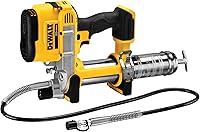
Our cordless grease gun guide covers the lubrication side of heavy equipment maintenance if that is your next purchase.
How do you match the tool to your battery platform?
Match the gun to the batteries you already own, because a bare tool without a charger is useless on day one. Battery platform often decides the purchase before torque does.
If you run DEWALT 20V MAX tools, the DCF964B slides onto the packs in your kit. If you run Milwaukee M18 tools, either Milwaukee gun works with your existing batteries.
Buying across platforms means adding a charger and packs to the cost. For the Milwaukee kit that cost is already folded in, since the charger and pack ship in the box.
Check the voltage too. The DEWALT lists 20 volts, while the Milwaukee guns run on the 18V M18 system.
Voltage alone does not rank power; the torque figures do that. A 20V label and an 18V label can sit on tools with very different outputs, so read the torque numbers rather than the voltage badge.
Think about how many tools share the platform. A gun that joins a system you already trust gets used more, since you never hunt for a charger.
A new platform adds a battery, a charger and a routine. That routine includes storage space and a place to keep the charger plugged in.
Pick the platform you already own unless the torque gap is decisive. The DEWALT's breakaway edge is real, but it may not be worth starting a second battery system.
If the 1,900 ft-lb figure is what your hardest fasteners need, the switch can pay off.
How heavy is too heavy for daily use?
Under about 7 lb is comfortable for repeated overhead work, and 9 lb or more suits ground-level jobs. Weight decides how long you can hold the gun up before your arms tire.
The Milwaukee 2864-20 is the lightest at 6.3 lb as a bare tool. Add a battery and it climbs, but it still starts lighter than the others.
That helps when you reach up to engine bay or lift hardware. Its 8.59-inch length also keeps it in the same footprint as the kit version.
The Milwaukee 2864-22R kit lists 15.7 lb with its battery, charger and case included. That figure covers the whole package, not the gun alone.
Expect the tool in hand to weigh less. The kit's rubber material and powder coated finish also mean a grip that resists slipping when your hands are oily.
The DEWALT lists 9 lb, the heaviest bare figure. That weight comes with its extra breakaway torque.
If most of your work is at chest height or below, the heft is easier to live with. The oil-resistant housing also means less worry about setting it down on a greasy shop floor.
Balance matters as much as the number. A gun with a battery at the base can feel steadier than a lighter tool with a top-heavy pack.
Hold one before you buy if the store allows it. A 15.7 lb kit box in one hand tells you less than the gun with a battery mounted in the other.
Pick the lighter Milwaukee for overhead and repeated work. Pick the DEWALT when the job is heavy and mostly at ground level.
Neither choice is wrong; the work decides.
What do the performance modes and profiles add?
Modes and profiles stop you from over-tightening small fasteners and let you save settings for repeat jobs. They turn a single-speed hammer into a tool with a low gear for delicate work.
The DEWALT's Precision Wrench mode is built to help prevent overtightening and fastener run-off. Its four-mode push button switch also changes LED brightness.
That matters when you thread a bolt by hand before the gun takes over. LED brightness sounds like a small thing until you are working under a frame with no shop light.
The Milwaukee 2864-22R lists four custom performance profiles. You set how the trigger responds and save it.
The 2864-20 adds ONEKEY, which manages those profiles from a phone. That is the main functional gap between the two Milwaukee tools.
These settings help when one gun covers several jobs. A low profile for small hardware, a full-power profile for lug nuts.
Without them, you rely on trigger feel alone. Trigger feel works until the fastener is different from the last one you touched.
More modes are not automatically better. What counts is whether the profiles match your work.
A truck shop may want two settings; a mixed repair bay may want four. The DEWALT's four-mode switch and the Milwaukee's four profiles land in the same territory on paper.
Pick the gun whose modes fit your fastener mix. The DEWALT's Precision Wrench mode suits buyers worried about overtightening.
The Milwaukee profiles suit buyers who repeat the same jobs and want saved settings.
Which 3/4 cordless impact wrench fits your work?
Pick the Milwaukee 2864-22R kit for most buyers, the DEWALT for maximum breakaway force, and the Milwaukee 2864-20 for existing M18 owners. Each wins on a different need.
The kit is the safest first buy. It brings 1,500 ft-lb breakaway, four profiles, and a battery and charger so you can work on arrival.
For a shop without Milwaukee batteries, it removes a separate purchase. It also folds the charger, the case and the battery into one order.
The DEWALT DCF964B is the pick when a rusted bolt refuses to move. Its 1,900 ft-lb breakaway is the highest here.
Accept the 9 lb weight and the bare-tool box as the price of that force. The oil-resistant housing offsets some of that cost in a dirty bay.
The Milwaukee 2864-20 suits a buyer already deep in M18 tools. It shares the kit's 1,500 ft-lb torque rating and 8.59-inch length, weighs 6.3 lb as a bare tool, and adds ONEKEY.
You supply the battery you already own.
Sort your work before you buy. If you loosen more than you tighten, lean DEWALT.
If you want one kit to cover a range of jobs, the 2864-22R is the best 3/4 cordless impact wrench for most people. Owners of M18 packs can save by taking the bare tool.
One last check: confirm the socket drive your wheels and equipment use before ordering. A 3/4-inch gun needs 3/4-inch sockets, and adapters sap torque.
That single detail protects the investment more than any spec on this page.
If your maintenance routine also covers greasing, the DeWalt grease gun vs Milwaukee grease gun comparison helps you stay on one battery platform.
Frequently asked questions
What is the difference between fastening torque and breakaway torque?
Fastening torque is the force the tool applies when tightening a bolt, while breakaway torque is the peak force it can apply to loosen a stuck fastener. A gun with high breakaway torque removes rusted nuts more easily, but its tightening force is set by the fastening rating.
Is a hog ring or friction ring anvil better on a 3/4 impact wrench?
A hog ring grips a socket with a spring ring and needs a firm pull to remove it, while a friction ring with a thru-hole holds the socket by friction and lets a pin pass through. Hog ring anvils suit sockets you keep on; friction ring anvils make swaps quicker.
Can a 3/4 cordless impact wrench remove lug nuts?
Yes, a 3/4-inch gun has enough torque for most truck and trailer lug nuts, but check the socket size your wheels use first. Light vehicle wheels often take a 1/2-inch drive, so match the anvil to your socket set rather than forcing an adapter.