How to Choose a Cordless Grease Gun
Choose a cordless grease gun around fitting access, grease control and battery compatibility. Favor longer reach for awkward equipment, careful dispensing for small grease amounts and higher flow for jobs that call for more grease.
On this page (8 sections)
- When is a cordless grease gun worth buying?
- How do you choose a cordless grease gun for your equipment?
- Which cordless grease gun fits your maintenance routine?
- Should you add a locking grease gun coupler?
- How should you set up a cordless grease gun?
- Which mistakes waste grease or damage equipment?
- How do you care for the gun between service rounds?
- Which cordless grease gun should you choose?
Choose a cordless grease gun by matching fitting access, grease control and battery compatibility to your equipment. A tool that reaches every service point and dispenses manageable amounts is a better choice than one chosen only for maximum pressure.
Start with your machine's lubrication instructions and the batteries you already have. Then check hose routing, room around each fitting and where the gun can rest while you work.
This guide compares 3 battery grease guns and a locking coupler. For a wider product comparison, see our best cordless grease guns.
When is a cordless grease gun worth buying?
A cordless grease gun makes sense when frequent greasing or many service points make manual pumping a chore. It also helps when you need to hold the hose at an awkward angle while operating the pump.
Count the fittings you service in a normal session, then consider how often that session happens. A few easy fittings several times a year may not justify adding another battery tool.
For trucks, tractors and other equipment with regular lubrication rounds, powered dispensing can reduce repeated hand pumping. The main buying question becomes how well the gun fits your route around the machine.
A cordless model still needs careful handling at each connection. It won't choose the right grease, find a missed fitting or tell you when a component has received enough lubricant.
If your work centers on larger equipment, our battery grease gun guide for trucks and farm equipment offers another way to compare the options.
How do you choose a cordless grease gun for your equipment?
Choose around access first, dispensing control second and battery fit third. Use pressure and maximum flow to check that the tool suits the job, rather than letting either number settle the choice.
| What to compare | Why it matters | What to check |
|---|---|---|
| Hose reach | Determines where you can place the gun | Measure the route to the hardest fitting |
| Coupler clearance | Affects attachment and removal | Check space around and behind the fitting |
| Pressure capability | Helps the pump overcome resistance | Follow the machine's lubrication limits |
| Flow control | Helps you manage small or large grease amounts | Compare trigger control, speed selection and counters |
| Priming aids | Help restore delivery after loading | Look for an air-bleeder valve |
| Battery system | Affects compatibility and charging | Confirm the exact pack family |
| Handling | Affects comfort during a service round | Consider support, hose storage and loaded weight |
Walk around your equipment before buying. Note any fitting that needs an extension, an angled approach or removal of a guard under the machine's service instructions.
Also decide where you'll put the gun at those points. A hose that reaches only when you suspend the whole tool may be less useful than it first appears.
Which cordless grease gun specs matter most?
Pressure, flow and delivery control describe different jobs. Pressure helps move grease against resistance, flow describes how quickly grease moves, and the controls help you manage the amount.
All 3 guns here have a maximum pressure of 10,000 PSI. That shared figure makes reach and control more useful ways to separate them for most buyers.
A higher maximum flow can shorten a job that calls for a large amount of grease. For small lubrication points, easy starts and stops matter more than emptying a cartridge quickly.
Maximum pressure and maximum flow aren't promises that both occur together at every fitting. Grease consistency, temperature and resistance can affect delivery.
Don't use trigger time as a universal measure of grease quantity. Follow the machine's specified amount or method, and use a counter only as directed by the tool manual.
How much hose reach do you need?
Choose enough hose to reach the fitting with slack for bends and a stable place for the gun. Measure the route the hose will actually follow, not just the straight-line distance.
Frames, tires and guards can consume reach. Check several difficult points rather than measuring only the easiest fitting near the edge of the machine.
Leave room to attach and release the coupler without pulling sideways on the Zerk. Extra hose cannot solve a connector that is too bulky for the space.
For connection technique, see our guide to using a grease gun on a Zerk fitting.
What battery and package details should you check?
All 3 grease guns here are tool-only models, so you need a compatible battery and charger. Start with a battery family you already use if its gun also meets your access and control needs.
Match the exact system, not just the voltage number or brand name. Packs from different families aren't interchangeable simply because their labels look similar.
Consider your charging routine as well as compatibility. Sharing one battery works poorly if another tool needs it during the same maintenance job.
Larger packs can add weight, so runtime isn't the only concern. Think about carrying the loaded gun between fittings and placing it safely while you connect the hose.
Which cordless grease gun fits your maintenance routine?
Choose DeWalt for variable trigger control, Milwaukee for a repeat service route or Ryobi for higher-flow work with reachable fittings. The coupler is a separate accessory for improving the connection, not an alternative to a powered gun.
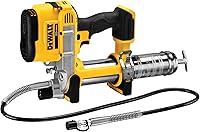
DeWalt DCGG571B: for gradual trigger control
The DeWalt suits buyers who want to control delivery directly with a variable speed trigger. Its 42 in hose gives room to position the tool away from the fitting while you work.
Maximum flow is up to 5 oz per minute. The integrated foot lets you rest the gun on a flat surface, and a shoulder strap is included for moving around equipment.
Choose it if your service round includes different grease amounts and you prefer to manage delivery through finger pressure. The support foot also matters if you can place the tool beside the machine instead of carrying it throughout the job.
Skip it if a preset dispensing counter is central to your routine. Milwaukee offers that feature, while the DeWalt focuses on trigger-based adjustment.
Buyers with several awkward fittings should measure access before settling on this hose length. Read the DeWalt DCGG571B grease gun review for a closer look at its features.
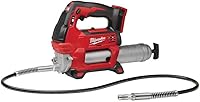
Milwaukee 2646-20: for repeat service rounds
The Milwaukee suits buyers who want speed selection and a preset grease counter for a planned maintenance route. Its 48 in hose is the longest of these 3 options.
The 2-speed design lets you select between maximum pressure and maximum flow. A lock-on/lock-off trigger, stand-up design and shoulder strap capability add options for handling the tool during longer rounds.
Choose it when you service many points and want a repeatable dispensing routine. Follow the manual for the counter's settings, then match those settings to each machine's lubrication instructions.
Skip it if you service only a few easy fittings and wouldn't use the added controls. Its 9 lb tool weight is also worth considering before adding grease and a battery.
Don't assume one counter setting suits every bearing or joint. Our DeWalt vs Milwaukee cordless grease gun guide helps compare the two control approaches.
Ryobi P3410: for higher-flow jobs within easy reach
The Ryobi suits buyers whose equipment calls for larger grease amounts and whose fittings are within its 30 in hose reach. Its maximum flow is up to 7.5 oz per minute.
It has a steel grease tube, onboard hose storage and plunger rod markings to help gauge the grease remaining. A lock-on/lock-off trigger supports longer dispensing runs when the machine's instructions call for them.
Choose it if you're already using a compatible battery system and don't need the longer reach of the other guns. Measure your hardest fitting before making battery compatibility the deciding factor.
Skip it if distant fittings force you to hold the tool in an awkward position. Its higher flow also gives little benefit when every point needs only a small amount.
Ryobi says it can pump up to 19 cartridges per charge with a P108 LITHIUM+ battery, which isn't included. Use that as a battery-specific runtime claim, not a promise for every pack or job.
Should you add a locking grease gun coupler?
Add a locking coupler if keeping the connector seated is the main difficulty at your fittings. Check thread compatibility and physical clearance before replacing the original coupler.
The LockNLube uses a 1/8 in NPT connection and works with SAE and metric Zerk fittings. Its thumb lever opens the jaws for attachment and removal, and LockNLube says it releases under pressure.
Choose it when you can reach the fitting but struggle to maintain a secure connection. Its rebuildable design and spare rebuild kit also suit buyers who prefer servicing the coupler rather than replacing the whole part.
Skip it if your current connector works well or the lever won't have room to move. Check space for the coupler body and your hand, especially at recessed fittings.
A secure connection doesn't repair a worn Zerk or blocked passage. Follow the gun's pressure-release procedure before removing the coupler from the hose or working on a pressurized connection.
How should you set up a cordless grease gun?
Start with the correct grease, a clean loading area and the tool's loading instructions. All 3 guns here have an air-bleeder valve to help prime the pump after loading.
Match the grease to the machine
Use the grease type and grade required by the equipment maker. Color alone isn't a reliable way to identify compatible grease, and mixing incompatible types can affect lubrication.
Label the gun if you keep more than one grease in the shop. A dedicated gun for each required type can reduce mix-ups and avoid repeated changeovers.
Load and prime before approaching the fitting
Keep dirt away from the open barrel and cartridge. Follow the tool manual for the follower rod, cartridge orientation and barrel assembly, since incorrect loading can leave the pump drawing air.
Prime into a suitable waste container until delivery is steady, following the manual's air-bleeding steps. Don't keep running the motor without grease while hoping an air pocket will clear itself.
Our guide to loading a cordless grease gun covers the general sequence. DeWalt buyers can also follow the model-focused guide to priming a DeWalt grease gun.
Prepare the machine and make the connection
Park and secure the equipment as its service instructions require. Never reach into moving machinery, and don't remove guards unless the service procedure permits it.
Wipe the Zerk before connecting, then seat the coupler straight. All 3 guns have an LED work light, but use extra lighting if you still cannot see the connection clearly.
Start with a brief, controlled application and watch the fitting and surrounding area. Stop according to the equipment's lubrication instructions rather than waiting for grease to appear somewhere on every component.
Which mistakes waste grease or damage equipment?
The most costly mistakes are overgreasing, forcing a blocked point and pumping through a dirty connection. A powered tool makes it easier to deliver grease quickly, so control matters at every fitting.
Holding the trigger against a blockage
Stop if grease won't enter, the hose moves sharply or grease escapes around the coupler. Check seating, fitting condition and the machine's service instructions before trying again.
Maximum tool pressure is a capability, not a target. Continuing to pump can damage a component or leave pressure trapped in the hose.
Using grease escape as the only stop signal
Some service procedures call for purging old grease, while others specify an amount or another stop point. Don't apply one method to every bearing, joint and seal.
Avoid lock-on operation where a point needs only a small dose. Keep control of the trigger and stop promptly when the required amount has been delivered.
Treating a leak as a reason to pump harder
Grease around the connector can mean poor alignment, worn parts or a damaged fitting. More trigger pressure won't correct the connection.
Release pressure as directed before adjusting anything. Never use a finger to search for a high-pressure leak, since grease injection through skin needs urgent medical care.
Pulling the hose to remove a stuck coupler
Use the coupler's release method instead of yanking the hose sideways. Pulling can strain the hose and damage the fitting.
If removal is difficult, stop and follow the pressure-release procedure. The connector should come off through the proper release action, not force against the Zerk.
How do you care for the gun between service rounds?
Keep the coupler clean, the hose protected and the grease clearly identified. These habits help the next service round start with fewer connection and loading problems.
Wipe away loose grease after use and protect the coupler from dirt during storage. Don't leave the hose dragged across a gritty floor or pinched under other tools.
Inspect the hose, coupler and threaded joints before each session. Replace damaged parts with suitable replacements rather than trying to seal a pressure leak with tape.
Remove the battery before maintenance or storage as directed by the tool manual. Store batteries according to their own instructions, away from conditions that could damage them.
If delivery becomes uneven, check grease supply, battery charge and priming before assuming the motor has failed. Our guide explains why a cordless grease gun may not pump and how to narrow down the cause.
Which cordless grease gun should you choose?
Choose your cordless grease gun by solving the hardest part of your actual service round. Use this decision order before comparing smaller convenience features.
- For gradual trigger control: Choose the DeWalt if you want to adjust delivery by finger pressure and its hose reaches your fittings.
- For planned, repeated lubrication: Choose the Milwaukee if speed selection, a preset counter and longer reach will help you follow the service route.
- For higher-flow work: Choose the Ryobi if your equipment needs larger grease amounts, its reach is enough and you have a compatible battery plan.
- For connection problems: Consider the LockNLube after confirming hose threads and room to operate its lever.
Keep a manual gun in consideration if your needs are limited to a few easy points. A cordless model earns its place when the work volume, access or repeated pumping makes powered delivery useful.
Before ordering, write down your required grease, hardest fitting, battery family and preferred control method. Then use the best cordless grease guns guide to compare tools against those needs.
Frequently asked questions
What should I look for in a cordless grease gun?
Start with fitting access, flow control and battery compatibility; measure the route to your hardest fitting, check room for the coupler and choose controls that suit the grease amounts your equipment needs. Then compare priming aids, tool support and whether the package includes a battery and charger.
Is a higher PSI cordless grease gun always better?
No, higher maximum pressure doesn't make a grease gun the better choice for every machine; reach, dispensing control and battery fit often matter more once pressure capability meets your needs. Follow the equipment's lubrication instructions, and stop to investigate a fitting that refuses grease rather than holding the trigger.
How long should a cordless grease gun hose be?
Choose enough hose to reach your hardest fitting from a stable tool position, with slack for bends; measure the actual route around frames and guards rather than a straight line. Also check coupler clearance, since extra hose length won't help if the connector cannot reach or release.
Do cordless grease guns come with a battery?
These 3 grease guns are tool-only models, so plan for a compatible battery and charger; if you already own cordless tools, confirm the exact battery family before choosing. Similar voltage numbers don't mean packs are interchangeable, and runtime claims apply to the battery and conditions named by the brand.