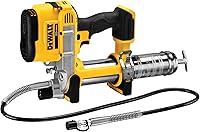
DeWalt DCGG571B 20V MAX Cordless Grease Gun Review: Worth It? (November 2026)
The DeWalt DCGG571 suits frequent equipment maintenance, especially if you already have compatible DeWalt batteries. Choose the DCGG571B for variable-speed flow control and a long hose; choose an alternative if you need included batteries or preset dispensing.
On this page (9 sections)
- Who should buy the DeWalt DCGG571?
- What do pressure and flow mean for your equipment?
- Will the hose reach your hardest fitting?
- What must you have before the first cartridge?
- Which alternative fits your maintenance routine?
- How should you load and prime the DeWalt?
- How do you avoid common greasing mistakes?
- What care keeps the gun ready for the next job?
- Should you choose the DeWalt DCGG571?
The DeWalt DCGG571 is a strong choice for regular equipment greasing when you want controlled delivery and already have compatible DeWalt power. The DCGG571B version suits buyers who can supply their own battery and charger.
Its main benefit is simpler lubrication across several fittings without repeated manual pumping. The variable-speed trigger also lets you slow down when a joint needs a small amount of grease.
Buy according to your equipment, battery setup and service routine. Maximum pressure matters less than correct grease, clean fittings and enough hose reach to work safely.
Who should buy the DeWalt DCGG571?
Choose the DCGG571B for frequent maintenance with awkward fittings, particularly when it fits your existing DeWalt battery setup. Skip it if you only grease a few easy-to-reach points occasionally and a manual gun already handles the work comfortably.
DeWalt DCGG571B 20V MAX Grease Gun: Best for regular equipment maintenance
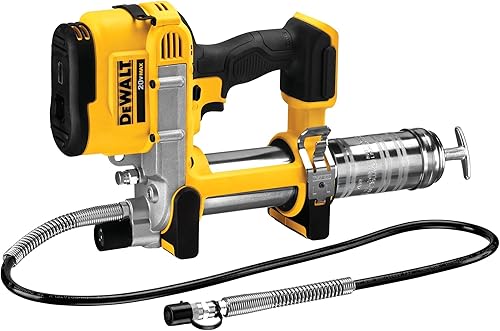
- Up to 10,000 PSI
- Up to 5 oz/min flow
- 42 in flexible hose
- Variable-speed trigger
Choose this tool-only model for regular lubrication when you already have compatible DeWalt power. Its variable-speed trigger helps you slow delivery at fittings that need small amounts.
Pros
- Variable-speed flow control
- LED illuminates dark fittings
- Integrated foot supports the tool on flat surfaces
- Shoulder strap included
Cons
- Battery and charger sold separately
- No preset grease counter
The LED helps you locate fittings in dark areas, while the integrated foot gives the gun a resting point on flat surfaces. These features are useful when you need to position the coupler with one hand and operate the tool with the other.
DeWalt includes a shoulder strap, but plan where the gun will sit during each task. Carrying a powered grease gun between machines is different from holding it at arm's length under equipment.
When does the DeWalt DCGG571 make sense?
It makes sense when repeated pumping is a regular part of your service work. Think about the number of lubrication points you service each month, rather than choosing from pressure figures alone.
A tractor, trailer or machine with several service points gives cordless operation a clear job. For equipment with only a few lubrication points, the extra battery, storage space and loading routine may offer less benefit.
Choose another model if preset dispensing is central to your routine. The DeWalt gives you trigger-based flow control, so you remain responsible for judging and following the required grease amount.
What do pressure and flow mean for your equipment?
Pressure moves grease against resistance; flow describes how quickly grease is delivered. The DeWalt offers up to 10,000 PSI and a maximum flow rate of 5 oz/min, but those figures serve different purposes.
Maximum pressure is reserve capability, not an instruction to keep pushing when a joint refuses grease. Dirt, a damaged fitting or a blocked passage needs attention before more force.
Maximum flow helps when a service point needs a larger amount. Small joints call for slower delivery, because overgreasing can damage seals or leave excess grease that collects dirt.
Use the variable-speed trigger to start gently and watch the fitting area. Follow the equipment maker's amount or service instructions instead of assuming every joint should be filled until grease appears.
A cordless gun also changes how quickly you can overfill a joint. Habits learned with a manual lever need care when grease continues to move for as long as you hold a powered trigger.
Will the hose reach your hardest fitting?
The DeWalt's 42-inch flexible hose suits fittings that sit away from a convenient resting spot. Measure the actual route to your hardest fitting before deciding that the reach is enough.
Allow for bends around parts and space to attach the coupler straight onto the zerk. A fitting may be close in a straight line but difficult to reach along a safe hose path.
Check whether you can see the connection and keep the trigger within comfortable reach. An LED helps with darkness, but it cannot create clearance around a fitting hidden behind another part.
The gun weighs 8 lb, so a stable resting point matters during a long service round. Keep the hose free of tension rather than using it to support or drag the tool.
Shut down and secure equipment according to its service instructions before reaching into it. Route the hose away from moving parts, sharp edges and hot surfaces.
What must you have before the first cartridge?
You need compatible battery power, a charger and the correct grease before this tool-only model is ready for work. Confirm compatibility rather than assuming any battery from the same brand will fit.
Include the whole setup in your decision if you are starting without cordless tools. A bare tool can fit an established workshop well while creating more buying steps for a new user.
The DeWalt accepts 14 oz grease cartridges. Choose grease by your equipment's requirements, including its specified grade and type, rather than by cartridge size alone.
Avoid mixing grease types unless compatibility is confirmed. If different machines require different greases, clearly label each gun so a quick service job does not put the wrong grease into a bearing or joint.
Keep clean rags, protective caps and the equipment's lubrication schedule nearby. These small items help you keep dirt out and track which fittings still need attention.
Which alternative fits your maintenance routine?
Choose Milwaukee for preset dispensing, Ryobi for accessible high-flow work with compatible batteries, or Seesii when included batteries matter most. These differences are more useful than selecting the largest pressure number.
Milwaukee: repeated lubrication rounds
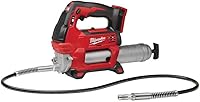
The Milwaukee 2646-20 suits buyers who work through repeat service points and want a preset grease counter. Its two-speed design lets you choose between maximum pressure and maximum flow operation.
The counter helps organize repeated dispensing tasks, but you still need the equipment's lubrication requirements. A setting suitable for one joint should not become the default for every fitting on the machine.
This bare tool makes the most sense if you already use compatible M18 power. Skip it if you do not need the counter and your current battery system already supports a suitable grease gun.
For more detail on the controls and practical differences, read our DeWalt vs Milwaukee cordless grease gun comparison.
Ryobi: accessible fittings and larger grease amounts
The Ryobi P3410 suits compatible Ryobi 18V battery owners who have reachable fittings and work that benefits from higher maximum flow. Its shorter hose is the key reason to check your equipment first.
Plunger markings help you judge the grease remaining in the tube, and on-board hose storage helps keep the hose contained between jobs. Its air-bleeder valve assists with priming after loading.
Skip it if reaching deep into equipment would require stretching the hose or holding the gun in an awkward position. Higher output does not make up for a coupler you cannot attach properly.
Seesii: a package with batteries included
The Seesii kit suits buyers building a grease-gun setup from scratch. Two batteries and a carrying case reduce the number of separate items you need to plan for.
Bulk loading offers another way to refill, but cartridges are generally easier to keep clean during occasional service work. Choose the loading method that matches your grease supply and ability to prevent contamination.
Skip this kit if your main goal is to share batteries with an established DeWalt, Milwaukee or Ryobi setup. Check charger inclusion before ordering, since included batteries alone do not complete the charging setup.
Our best cordless grease guns guide covers more choices if these four do not fit your equipment.
How should you load and prime the DeWalt?
Load cleanly, release trapped air and confirm steady output before attaching the coupler. The DeWalt's air-bleeder valve assists with priming after cartridge changes.
Remove the battery before loading or handling parts where an accidental trigger press could create a mess or injury. Follow DeWalt's instructions for the plunger, cartridge seals and barrel assembly.
Wipe the barrel opening and nearby surfaces before opening the gun. Keep the new cartridge's exposed grease away from dirt, metal filings and dirty gloves.
After loading, follow the prescribed priming procedure and direct the coupler toward a suitable waste container. Do not begin at a machine fitting while you are still unsure whether the pump is delivering grease.
If the motor runs but grease does not appear, stop and check for trapped air or a loading error. Repeated trigger pulls are a poor substitute for correcting the cause.
Use our DeWalt grease gun priming steps for that process. If loading is the uncertain part, start with how to load a cordless grease gun.
How do you avoid common greasing mistakes?
Clean the fitting, connect squarely and dispense only the required amount. Most routine mistakes come from contamination, a poor connection or continuing after enough grease has entered.
Wipe each zerk before attaching the coupler. Grease carried through a dirty connection can take grit into the part you are trying to protect.
Seat the coupler straight and check for leakage around the fitting as you begin. Grease escaping at the connection is a reason to stop and check the connection, not proof that the joint is full.
Do not apply the same trigger time to every fitting. Different joints can need different amounts, and grease delivery changes with resistance and trigger position.
Never use a finger to search for a pressurized leak or press against grease escaping from the hose. High-pressure grease can penetrate skin, so stop work and remove pressure according to the tool's instructions before inspection.
If the coupler resists removal, release pressure using the recommended procedure rather than pulling hard on the hose. Our guide to using a grease gun on a zerk fitting explains the connection and dispensing routine.
What care keeps the gun ready for the next job?
Keep dirt out, protect the hose and inspect the gun before each use. Clean storage helps prevent the next lubrication task from starting with contamination or damaged parts.
Wipe grease from the outside after work and cover the coupler for storage. Keep the gun where loose dirt cannot collect around the grease barrel or connection.
Inspect the hose and coupler for damage or leaks before pressurizing them. Follow the tool's instructions for replacement parts rather than continuing with a damaged hose.
Store the hose without tight kinks, and avoid stacking heavy items over it. Remove the battery before maintenance and follow the battery maker's storage guidance.
If output stops later, check the grease supply, battery charge, cartridge loading and trapped air before blaming a blocked machine fitting. Our guide to why a cordless grease gun may stop pumping helps narrow down the cause.
Should you choose the DeWalt DCGG571?
Choose the DeWalt DCGG571B if you service equipment often, want direct trigger control and have compatible DeWalt power. Before ordering, confirm that you can reach the hardest fitting from a stable working position.
Choose Milwaukee if preset dispensing would improve your service rounds, Ryobi if its reach fits your equipment and batteries, or Seesii if included batteries are the priority. Stay with a manual gun if occasional greasing gives a powered model little useful work.
Use your equipment's grease requirements and fitting locations to make the final call. Our cordless grease gun buying guide can help you check those needs before committing to a battery platform.
Frequently asked questions
What is the pressure of the DeWalt DCGG571B?
The DeWalt DCGG571B delivers up to 10,000 PSI; this is a maximum capability, not a pressure target for routine lubrication. Follow your equipment's grease requirements, and stop if a fitting will not accept grease rather than holding the trigger down against a blockage.
Does the DeWalt DCGG571B come with a battery?
No, the DCGG571B is a tool-only model without a battery or charger; the package includes the grease gun and shoulder strap. Confirm that your existing DeWalt battery and charger are compatible, or include both in your buying plan before choosing this version for your maintenance work.
How long is the DeWalt DCGG571B hose?
The DeWalt DCGG571B has a 42-inch flexible hose. Check the route from a stable resting spot to your equipment's hardest fitting, allowing room for bends and coupler access; the hose must reach without being stretched, pinched, or routed across hot surfaces or moving parts.
How do you prime a DeWalt DCGG571B?
Prime the DCGG571B using DeWalt's loading procedure and its air-bleeder valve to release trapped air; aim for steady grease delivery before connecting to equipment. If the motor runs without output, check cartridge loading and trapped air first; our DeWalt grease gun priming guide explains the next steps.