7 Best Milwaukee Impact Wrenches for Automotive Work (November 2026)
The best Milwaukee impact wrenches for automotive work include the Milwaukee M18 FUEL 3/8" Compact Impact Wrench for tight engine bay work, the Milwaukee 2767-20 M18 Fuel High Torque 1/2" for rusted hub and axle nuts, and the Milwaukee 2962-20 M18 18V Fuel 1/2" Mid-torque (best all-round 1/2-inch choice).
On this page (5 sections)
The best Milwaukee impact wrench for automotive work is the M18 FUEL 3/8 Compact Impact Wrench, because its 4.8-inch body reaches brake and suspension bolts while 250 ft-lbs of nut-busting torque still breaks loose most fasteners. The M18 FUEL High Torque 1/2 is the pick when you need 1,400 ft-lbs for rusted hub and axle nuts.
Your choice really comes down to two things: how much torque the fastener needs and how much room you have to swing the tool. A big 1/2-inch gun is useless if it can't fit between the strut and the fender.
Torque and access pull in opposite directions across this lineup. The compact 3/8 gives up socket size to stay short, while the high torque 1/2 gives up clearance to gain breakaway force.
The middle models try to split the difference.
For the socket end of the job, our guide to the best 1/2 cordless impact wrench covers non-Milwaukee options too. If you're building out an M12 kit, the M12 ratchet vs M12 FUEL ratchet comparison explains where the ratchets fit next to an impact wrench.
Our picks at a glance
-
1
 Best for tight engine bay work
Milwaukee M18 FUEL 3/8" Compact Impact Wrench
9.7/10 our score
See it on Amazon -
2
 Best for rusted hub and axle nuts
Milwaukee 2767-20 M18 Fuel High Torque 1/2"
9.4/10 our score
See it on Amazon -
3
 Best all-round 1/2-inch choice
Milwaukee 2962-20 M18 18V Fuel 1/2" Mid-torque
9.0/10 our score
See it on Amazon
- 4
 Check it
Milwaukee FUEL 2854-20 3/8 Brushless Cordless Impact
Best for brake and suspension bolts - 5
 Check it
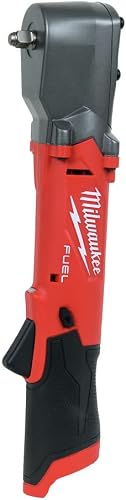
Milwaukee Right Angle Impact Wrench
Best for firewall and frame access - 6
 Check it
Milwaukee M12 FUEL Stubby 1/2 Inch Impact
Best for light duty in tight spots - 7
 Check it
Milwaukee M12 FUEL 1/2" Right Angle Impact
Best for hidden 1/2-inch fasteners
The best Milwaukee impact wrenches for automotive jobs
Each wrench here wins a specific job, from hub nuts to hidden firewall bolts. The compact 3/8 is the best all-round starting point for a home mechanic, and the rest fill in the gaps around it.
Milwaukee M18 FUEL 3/8" Compact Impact Wrench: Best for tight engine bay work
- 4.8-inch length
- 250 ft-lbs nut-busting torque
- 4-Mode DRIVE CONTROL
- Tri-LEDs around the anvil
- Auto shut-off at 20 ft-lbs
Short enough for confined engine bay bolts yet strong enough for most brake and suspension fasteners. The four drive modes keep hand-tight work from getting overtightened.
Pros
- Shortest body in this group
- Four drive modes with auto shut-off
- Tri-LED lighting around the anvil
Cons
- Bare tool only, no battery or charger
- 3/8 drive limits socket size for big lug nuts
This is the wrench most home mechanics should buy first. The 4.8-inch body is the shortest here, so it slips between the caliper and the wheel well or down beside the engine block where a full-size gun won't go.
At 250 ft-lbs of nut-busting torque, it handles brake bracket bolts, strut mounts and most suspension hardware on passenger cars.
The 4-Mode DRIVE CONTROL is what makes it usable beyond heavy fasteners. Mode 4's auto shut-off caps torque at 20 ft-lbs for hand-tight work, so you can run in small trim and interior bolts without stripping them.
Mode 4 also includes bolt removal control, which drops RPMs once a fastener breaks loose so the socket doesn't walk off with the nut. Tri-LEDs sit around the anvil, so the light lands where the socket is going rather than casting a shadow over it.
The trade-off is the 3/8 anvil. It limits you to smaller sockets, so the biggest lug nuts and axle nuts will want the 1/2-inch high torque model.
It's also a bare tool, so factor in an M18 battery and charger if you're starting fresh. The 4.96 oz figure covers the tool itself, which stays light enough to hold overhead at awkward angles.
For a first automotive impact wrench, though, this is the one to build around.
Milwaukee 2767-20 M18 Fuel High Torque 1/2": Best for rusted hub and axle nuts
- 1,000 ft-lbs fastening torque
- 1,400 ft-lbs nut-busting torque
- 1/2-inch friction ring anvil
- REDLINK PLUS electronics
The 1/2-inch big gun for jobs where smaller tools stall. Its 1,400 ft-lbs of breakaway torque takes on hub nuts and frame bolts without a breaker bar.
Pros
- Highest torque in this group
- One-handed socket changes
- Runs on any M18 battery
Cons
- Longest and heaviest pick here
- Overkill for interior and trim fasteners
Buy this when the fastener has been rusted in place for years. The 2767-20 delivers 1,000 ft-lbs of fastening torque and 1,400 ft-lbs of nut-busting torque, which is more than twice the breakaway force of anything else in this group.
Hub nuts, axle nuts, frame bolts and suspension hardware that would normally need a breaker bar and a length of pipe come off with the trigger.
The 1/2-inch friction ring anvil lets you change sockets one-handed, which matters when you're lying under a car holding the tool up. REDLINK PLUS electronics protect the tool and battery from overload and heat during long jobs.
It runs on any M18 battery, so it shares packs with the compact 3/8.
The catch is size. At 9.65 inches and 6 lb, it's the longest and heaviest wrench here, so it won't fit in tight engine bay spots.
The rubber overmold grip helps when your hands are slick, but the weight still tells after a few minutes overhead. It's also more tool than you need for interior and trim fasteners.
Keep the compact 3/8 for those jobs and bring this out for the heavy stuff.
Milwaukee 2962-20 M18 18V Fuel 1/2" Mid-torque: Best all-round 1/2-inch choice
- 1/2-inch friction ring
- Tri-LED work lights
- Auto shut-off at 35 ft-lbs
- Bolt removal control
- 3.9 lb body
A middleweight 1/2-inch wrench that hits the sweet spot between the compact and high torque models. Good for lug nuts on passenger cars and light truck work.
Pros
- Lighter than the high torque model
- Bolt removal control stops dropped fasteners
- Friction ring for quick socket swaps
Cons
- Auto shut-off caps torque at 35 ft-lbs in that mode
- 1/2 drive only, no 3/8 anvil
The 2962-20 is the middleweight 1/2-inch option. It sits between the compact 3/8 and the high torque model, giving you a 1/2-inch anvil for lug nuts without the bulk of the 2767-20.
At 3.9 lb it's noticeably lighter than the high torque gun, so it's easier to hold overhead or work with for longer stretches.
Bolt removal control is the feature that stands out for automotive use. It delivers full torque to break a fastener loose, then drops the RPMs once the bolt is spinning free, so the socket doesn't walk off and drop the nut into the engine bay.
The friction ring makes socket changes quick, and tri-LEDs light the workspace.
Auto shut-off caps torque at 35 ft-lbs in that mode, which is higher than the compact 3/8's 20 ft-lbs but still low enough for hand-tight fastening. The 10-inch length is the main limitation.
It's longer than the compact 3/8, so tight spots still favor the smaller tool. Pick this if you want one 1/2-inch wrench for most lug and suspension work and don't plan to buy two.
Milwaukee FUEL 2854-20 3/8 Brushless Cordless Impact: Best for brake and suspension bolts
- 250 ft-lbs nut-busting torque
- 5-inch length
- Friction ring anvil
- 4-mode drive control
- Auto shut-off and bolt removal control
A 3/8-inch M18 option with the same torque figure as the compact pick but a slightly longer body. Suits brake caliper and suspension work on cars and light trucks.
Pros
- 250 ft-lbs in a 2.7 lb body
- Four drive modes
- Friction ring socket changes
Cons
- An inch longer than the compact pick
- Bare tool only
The 2854-20 matches the compact 3/8 on torque at 250 ft-lbs, but its body runs 5 inches rather than 4.8. That extra fifth of an inch won't matter in most spots, and it still weighs just 2.7 lb.
It's a solid 3/8-inch M18 option for brake caliper bolts and suspension work.
The feature set is the same story as the compact pick: four drive modes, friction ring socket changes, auto shut-off and bolt removal control. The 18-volt platform means it shares batteries with the rest of the M18 line.
Where it loses ground is access. The compact 3/8 is the shortest body in this group, so when a bolt sits right up against a frame rail or firewall, those 0.2 inches can decide whether the socket seats.
Choose the 2854-20 for brake and suspension work where clearance is normal, and keep the compact pick as the tight-space specialist. It's also a bare tool.
Milwaukee Right Angle Impact Wrench: Best for firewall and frame access
- 90-degree right angle head
- 220 ft-lbs torque
- 3/8-inch drive
- Hardened steel body
- 2.83 lb
The 90-degree head slides into spots a straight wrench can't reach, like firewall bolts and frame rail fasteners. Runs on the smaller M12 battery platform.
Pros
- Right angle head for cramped fasteners
- 220 ft-lbs in a light body
- Hardened steel construction
Cons
- Lower torque than the straight 3/8 picks
- 14.5-inch length still needs swing room
Some fasteners can't be reached with a straight tool no matter how short it is. The 90-degree head on this right angle wrench slides in sideways, which is what you want for firewall bolts, frame rail fasteners and anything tucked behind the engine.
It delivers 220 ft-lbs from a 2.83 lb body on the M12 platform.
The 3/8-inch drive keeps sockets small enough to fit in those tight spots. Hardened steel construction holds up to repeated use, and the light weight means you can hold it at an awkward angle without your arm giving out.
The friction ring handles socket changes. It's the tool you reach for when the compact 3/8 won't fit straight on.
The limitation is torque. At 220 ft-lbs it's below the straight 3/8 picks, so it's not the wrench for rusted hub nuts.
The 14.5-inch length also needs some swing room around the head, so plan your approach before you commit. It works best as a second or third wrench in an M12 kit rather than your only impact.
Milwaukee M12 FUEL Stubby 1/2 Inch Impact: Best for light duty in tight spots
- 550 ft-lbs nut-busting torque
- 4.9-inch body
- 4-Mode DRIVE CONTROL
- Auto shut-off
- REDLINK PLUS electronics
A 1/2-inch anvil in a stubby M12 body, so it fits places the full-size M18 tools won't. Best for lighter lug work and fasteners that don't need brute force.
Pros
- Short 4.9-inch body
- 1/2-inch drive with 550 ft-lbs
- Light 1.9 lb build
Cons
- Lower torque than the M18 high torque pick
- M12 battery platform only
The M12 FUEL Stubby puts a 1/2-inch anvil on a 4.9-inch body that weighs just 1.9 lb. That combination is unusual: most 1/2-inch wrenches are long and heavy.
It means you can get 1/2-inch sockets into places the M18 high torque gun can't reach, and hold the tool up for longer without fatigue.
At 550 ft-lbs of nut-busting torque, it covers lighter lug work and fasteners that don't need the full 1,400 ft-lbs of the high torque model. Four drive modes with auto shut-off keep it controlled for smaller fasteners.
The POWERSTATE brushless motor and REDLINK PLUS electronics are the same family used across the M18 line.
The trade-off is straightforward: it's an M12 tool with M12 torque. If a lug nut is rusted solid, this wrench will struggle where the 2767-20 won't.
It's best as a light-duty companion for tight spots and smaller vehicles, not as your primary lug nut tool. Budget for M12 batteries if you don't already have them.
Milwaukee M12 FUEL 1/2" Right Angle Impact: Best for hidden 1/2-inch fasteners
- Right angle 1/2-inch head
- 220 ft-lbs torque
- Friction ring anvil
- Bare tool only
A 1/2-inch right angle wrench for bolts that sit out of reach of a straight tool. Suits transmission mounts and engine bay fasteners with limited clearance.
Pros
- 1/2-inch drive at a right angle
- Friction ring for socket changes
- M12 platform keeps the body light
Cons
- 220 ft-lbs is modest for 1/2 drive
- Long 14.2-inch reach needs clearance to swing
This is the 1/2-inch version of the right angle idea. The 90-degree head reaches hidden 1/2-inch fasteners like transmission mounts and engine bay bolts that a straight wrench can't touch.
The friction ring lets you swap sockets without fighting the tool.
It delivers 220 ft-lbs from a 3.3 lb body on the M12 platform. The 14.2-inch length gives it reach into deep spots, though you'll want to check there's room to swing the head before you commit to an angle.
It's the pick when the fastener is 1/2-inch and out of sight.
The torque figure is the weak point. 220 ft-lbs is modest for a 1/2-inch drive, so this is a precision-access tool rather than a breaker.
It won't remove rusted hub nuts that the high torque model takes in stride. Buy it for the specific job of reaching hidden fasteners, and keep a straight impact for the heavy lifting.
It's a bare tool on the M12 platform.
How these Milwaukee impact wrenches compare
The comparison table lines up drive size, torque and length so you can see where each wrench sits. Torque figures follow Milwaukee's own ratings, and the auto shut-off values are separate from the maximum nut-busting numbers.
| Product | Best for | Drive size | Torque | Length | Our score |
|---|---|---|---|---|---|
| Milwaukee M18 FUEL 3/8" Compact Impact Wrench | tight engine bay work | 3/8 in | 250 ft-lbs | 4.8 in | 9.7 |
| Milwaukee 2767-20 M18 Fuel High Torque 1/2" | rusted hub and axle nuts | 1/2 in | 1,000 ft-lbs fastening | 9.65 in | 9.4 |
| Milwaukee 2962-20 M18 18V Fuel 1/2" Mid-torque | all-round 1/2-inch choice | 1/2 in | 35 ft-lbs in shut-off mode | 10 in | 9.0 |
| Milwaukee FUEL 2854-20 3/8 Brushless Cordless Impact | brake and suspension bolts | 3/8 in | 250 ft-lbs | 5 in | 8.7 |
| Milwaukee Right Angle Impact Wrench | firewall and frame access | 3/8 in | 220 ft-lbs | 14.5 in | 8.1 |
| Milwaukee M12 FUEL Stubby 1/2 Inch Impact | light duty in tight spots | 1/2 in | 550 ft-lbs | 4.9 in | 8.0 |
| Milwaukee M12 FUEL 1/2" Right Angle Impact | hidden 1/2-inch fasteners | 1/2 in | 220 ft-lbs | 14.2 in | 7.9 |
How we compared these impact wrenches
We compared these Milwaukee impact wrenches on the specs that decide whether a tool fits an automotive job: drive size, nut-busting torque, body length, weight and drive mode features. We weighed each one against what the job actually needs, not against raw power alone.
Drive size came first. A 3/8-inch anvil fits brake, suspension and engine bay fasteners, while a 1/2-inch anvil is the better fit for lug nuts and axle hardware.
The right choice depends on the fasteners you touch most.
Length and weight came next. Access matters more than torque in a crowded engine bay, so the 4.8-inch compact 3/8 earns its top score partly on size.
A long, heavy gun that can't fit is less useful than a shorter one with enough torque for the job. The stubby M12 shows the same logic from the other direction, trading M18 power for a 4.9-inch body.
We also looked at the drive mode features. Auto shut-off and bolt removal control change how the tool behaves on small fasteners and loose bolts.
These are practical features for automotive work, not marketing extras, and the 20 ft-lb and 35 ft-lb caps are useful reference points when you're matching a mode to a fastener.
Our score weighs specs and features against what you're shopping for. The compact 3/8 leads because it balances access and torque better than any other pick for typical home mechanic work.
The high torque model scores just behind it because its power is exceptional but its size limits where it fits. The right angle picks sit lower because their torque ceiling is the lowest here, even though their access is unmatched for the fasteners they're built for.
If you're also stocking up on lubrication tools, our DeWalt grease gun vs Milwaukee grease gun comparison covers the other half of a garage kit. And if you want to know how impact wrenches stack up against other electric fastening tools, the best electric torque wrench guide is a good next read.
Which Milwaukee impact wrench fits your automotive work?
Start with the fasteners you remove most often. If you work on brakes, suspension and engine bay bolts, a 3/8-inch compact wrench is the right tool.
If lug nuts and axle hardware dominate your jobs, step up to 1/2 inch.
Should you buy a 3/8 or 1/2 inch Milwaukee impact wrench?
A 3/8-inch impact wrench is the better fit for brake, suspension and engine bay work because it's smaller and fits tighter spaces. A 1/2-inch wrench is better for lug nuts, axle nuts and heavier hardware where torque matters more than access.
Many home mechanics end up owning one of each.
Within this group, the compact 3/8 is the best starting point for general automotive work. The M18 FUEL High Torque 1/2 is the one to add when you hit rusted lug nuts that the smaller tool can't move.
How much torque do you need for lug nuts?
For most passenger cars and light trucks, 250 ft-lbs of nut-busting torque is enough to remove lug nuts. For rusted or heavy-duty lug nuts, you want more headroom, and 1,000 ft-lbs or more gives you that margin.
The M18 FUEL High Torque 1/2 with 1,400 ft-lbs covers the heaviest cases here.
Do you need an M18 or M12 Milwaukee impact wrench?
M18 tools are larger and more powerful, so they suit heavy fasteners and lug nuts. M12 tools are smaller and lighter, which makes them better for tight access and light-duty work.
The compact 3/8, high torque and mid-torque 1/2-inch models run on M18; the Stubby and right angle wrenches use M12.
If you already own M18 batteries, staying on that platform avoids buying a second set of packs. If you're building a light kit for interior and small-fastener work, the M12 line makes more sense.
The M12 Stubby is the strongest case for the smaller platform, since its 550 ft-lbs covers more than the right angle tools.
Is a right angle impact wrench worth it for automotive work?
Yes, if you regularly reach fasteners that a straight tool can't touch. A right angle head slides in sideways for firewall bolts, frame rail fasteners and hidden engine bay hardware.
The trade-off is lower torque: 220 ft-lbs on both right angle models here, compared with 250 ft-lbs on the straight 3/8 picks and 1,400 ft-lbs on the high torque gun.
The 1/2-inch right angle gives you a bigger socket size for hidden fasteners, while the 3/8 version fits smaller spaces. Either works as a companion to a straight wrench, not as your only impact.
It solves an access problem that no straight tool can.
What do the drive modes do on these wrenches?
The 4-Mode DRIVE CONTROL lets you pick preset RPM and IPM levels for different jobs. Mode 4's auto shut-off limits torque so you don't overtighten small fasteners, and bolt removal control drops RPMs once a bolt is loose so it doesn't fall.
The compact 3/8 caps auto shut-off at 20 ft-lbs, and the mid-torque 1/2 at 35 ft-lbs.
The best Milwaukee impact wrench for automotive work: final verdict
The M18 FUEL 3/8 Compact Impact Wrench is the best Milwaukee impact wrench for automotive work for most home mechanics. Its 4.8-inch body and 250 ft-lbs of nut-busting torque handle the brake and suspension jobs that fill most weekends, and the four drive modes keep it controlled on smaller fasteners.
Step up to the M18 FUEL High Torque 1/2 if rusted hub and axle nuts are a regular problem. Choose the M12 FUEL Stubby for light work in tight spots, and the right angle wrenches when a fastener sits where a straight tool can't go.
Pick the compact 3/8 first, then add the others as your jobs demand.
Our top 3 picks at a glance
-
1
Best for tight engine bay work
Milwaukee M18 FUEL 3/8" Compact Impact Wrench
9.7/10 our score
See it on Amazon -
2
Best for rusted hub and axle nuts
Milwaukee 2767-20 M18 Fuel High Torque 1/2"
9.4/10 our score
See it on Amazon -
3
Best all-round 1/2-inch choice
Milwaukee 2962-20 M18 18V Fuel 1/2" Mid-torque
9.0/10 our score
See it on Amazon
Frequently asked questions
Do Milwaukee impact wrenches come with a battery?
Most of the picks here are bare tools, so no battery or charger is included. You'll need an M18 or M12 REDLITHIUM pack depending on the model.
Factor in that pack and a charger if you don't already own the platform.
What is the difference between M12 and M18 Milwaukee impact wrenches?
M12 tools are smaller and lighter but produce less torque, like the 550 ft-lbs M12 FUEL Stubby. M18 tools are larger and stronger, like the 1,400 ft-lbs High Torque.
Pick M12 for light work and tight access, and M18 for heavy fasteners.
What does auto shut-off mode do on a Milwaukee impact wrench?
Auto shut-off mode limits torque to a preset level so you don't overtighten small fasteners. The compact 3/8 model caps it at 20 ft-lbs, and the mid-torque 1/2 model at 35 ft-lbs.
Use it for hand-tight applications like trim and interior bolts.
Can a Milwaukee impact wrench remove lug nuts?
Yes. The M18 FUEL High Torque 1/2 with 1,400 ft-lbs of nut-busting torque handles most lug nuts, including stubborn ones.
The compact 3/8 model also works on many passenger car lug nuts, though tight or rusted ones may need the bigger tool.
Is a 3/8 or 1/2 inch impact wrench better for automotive work?
A 3/8-inch impact wrench is better for brake, suspension and engine bay fasteners because it's smaller and fits tighter spaces. A 1/2-inch wrench is better for lug nuts and axle hardware where you need more torque.
Many home mechanics own both.


