Milwaukee 2646-20 M18 Grease Gun Review: Worth It? (November 2026)
The Milwaukee 2646-20 suits M18 owners who grease equipment regularly, especially when fittings are awkward to reach. Its two speeds and preset grease counter help manage delivery, but the bare tool needs a compatible battery and charger.
On this page (10 sections)
- What does the Milwaukee 2646-20 offer?
- Who should buy it, and who should skip it?
- How does Milwaukee compare with the DeWalt DCGG571B?
- Is the Milwaukee M12 a better fit for smaller jobs?
- When is the Alloyman kit worth considering?
- What should you check before choosing a grease gun?
- How should you set up the Milwaukee before its first job?
- How do you use it without overgreasing or making a mess?
- What care habits prevent avoidable problems?
- Should you buy the Milwaukee 2646-20?
The Milwaukee 2646-20 is a good choice for M18 users who grease equipment regularly and need room to reach awkward fittings. Its controls suit a maintenance route with different grease requirements, rather than a few easy fittings serviced once in a while.
The main buying question is whether those controls and the extra reach will earn their place in your routine. Battery ownership, carrying weight and fitting access matter more than choosing the highest pressure number.
What does the Milwaukee 2646-20 offer?
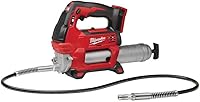
The 2646-20 combines a 48-inch flexible hose, two speeds and a preset grease counter. Its maximum operating pressure is 10,000 PSI, with speed settings that let you choose maximum pressure or maximum flow.
Milwaukee 2646-20 M18 2-Speed Grease Gun: Best for regular M18 users

- Up to 10,000 PSI
- 48 in flexible hose
- Two speeds
- Preset grease counter dial
Choose this bare tool for regular maintenance when you already use M18 batteries. Its long hose and preset counter suit routes with awkward fittings and measured grease amounts.
Pros
- Long hose helps reach awkward fittings
- Two speeds select pressure or flow
- Preset counter helps manage delivery
- Air bleeder valve assists priming
Cons
- Battery and charger sold separately
- 9 lb tool adds carrying weight
The counter gives you a way to set delivery instead of relying only on trigger time. It is useful when your service instructions call for a measured amount, but you still need to match the setting to the equipment's requirement.
An air bleeder valve helps release trapped air during priming. An LED lights the work area, while markings on the plunger rod help you gauge how much grease remains.
The gun also has a lock-on/lock-off trigger, a stand-up design and shoulder strap capability. Those features give you options for positioning and carrying it, although a strap should not be assumed to come with this bare tool.
Who should buy it, and who should skip it?
Buy it for repeat maintenance where access and controlled delivery save effort. Skip it if your current manual gun handles a few accessible fittings without slowing you down.
When the Milwaukee 2646-20 fits your routine
This model makes sense for someone moving through multiple grease points on equipment, especially when the gun cannot sit right beside each fitting. You can position the body on a suitable surface and work with the hose instead of holding the whole tool at the connection.
The preset counter is most useful when you know how much grease each point needs. A service chart with different amounts gives that control a clear purpose.
Existing M18 battery ownership also makes the decision easier. Keep in mind that an M12 pack is not a substitute for the M18 power this tool requires.
When a smaller or simpler gun makes more sense
The tool weighs 9 lb, so carrying it across a yard or around several machines deserves thought. Include the battery, grease and any carrying accessories when judging the load you'll actually handle.
For occasional maintenance, a manual gun avoids adding another battery tool to store and charge. For frequent work in tight spaces, consider whether a shorter body matters more than the M18's hose reach.
How does Milwaukee compare with the DeWalt DCGG571B?
Choose Milwaukee for its preset counter and longer hose; choose DeWalt for variable trigger control or existing DeWalt batteries. Both have the same maximum pressure, so pressure alone does not separate them.
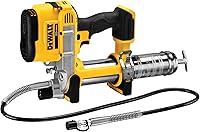
The DeWalt DCGG571B has a 42-inch hose and a pump rated for up to 5 oz/min. Its variable speed trigger lets you adjust grease flow with your finger as you work.
Milwaukee's counter suits a planned amount at each point. DeWalt's trigger suits someone who prefers to adjust delivery directly, although careful trigger use still needs a known lubrication target.
DeWalt also has an integrated foot for resting the gun on flat surfaces. It is a tool-only option, so buyers new to that platform must account for compatible power.
Skip the DeWalt if your current M18 setup already suits the job and the counter is a feature you'll use. Switching platforms needs a practical benefit beyond a different trigger.
Read our DeWalt DCGG571B grease gun review for more detail. Our DeWalt vs Milwaukee cordless grease gun comparison walks through the choice between the two brands.
Is the Milwaukee M12 a better fit for smaller jobs?
Choose the Milwaukee 2446-20 M12 when a shorter, lighter tool matters more than extra hose reach. Its 14-inch body and 7.2 lb weight make it worth considering for a setup you carry often.
The M12 has a 36-inch hose and develops over 8,000 PSI. Check the actual route to your fittings before choosing it, since a shorter hose may force you to move the gun more often.
Integrated hose storage helps keep the hose contained between jobs, and the LED fuel gauge helps you check battery status. Milwaukee claims up to 7 cartridges per charge, but that is not a fixed result for every work pattern.
This is a sensible choice for an M12 user whose fittings are within reach. Skip it if the shorter hose would leave the gun hanging from the connection or require awkward positioning.
The battery and charger are separate here too. Staying with Milwaukee does not mean the M12 and M18 models share batteries.
When is the Alloyman kit worth considering?
Consider the Alloyman kit if you need included batteries and want to switch between pistol and straight modes. It comes with two 4.0Ah batteries, making it a different starting point from the three bare-tool choices.
Alloyman rates the gun for up to 12,000 PSI and 5.3 oz/min, with a 39.4-inch hose. Those figures do not make it the right choice for a fitting that needs only a small amount of grease.
The stated weight is 12.78 lb, so it is less appealing for buyers focused on carrying comfort. Skip it if you already have a suitable battery platform and would gain little from the included packs.
Confirm the cartridge dimensions it accepts before ordering. The cartridge capacity information is unclear, and that matters if you want to use grease cartridges already stocked in your workshop.
What should you check before choosing a grease gun?
Check your grease requirements, fitting access and full battery setup before comparing extras. These checks help you avoid buying a capable tool that is awkward to use on your equipment.
Start with the equipment's service instructions. Note the grease type, service interval and amount required at each point; the gun's maximum output does not replace that guidance.
Next, trace the hose path from a stable tool position to your hardest fitting. Allow for corners, guards and enough slack to attach the coupler without pulling sideways.
Check the space around the fitting as well as the distance to it. A hose may reach while the coupler still lacks room to line up properly.
Finally, consider your whole maintenance route. A gun that rests beside one machine may need to be carried constantly on another, changing how much weight and body size matter.
Our cordless grease gun buying guide explains how to weigh these choices if you're still deciding between tool formats.
How should you set up the Milwaukee before its first job?
Load the correct grease, prime the gun and establish steady flow before connecting to equipment. Follow Milwaukee's manual for the loading sequence and control settings.
Loading and priming the Milwaukee 2646-20
Clean the area where you'll open the barrel, and keep dirt away from grease and exposed parts. Use the lubricant specified for the equipment rather than choosing grease only because it is already available.
Remove the battery before loading or doing maintenance. Follow the instructions for the follower rod and barrel, then use the air bleeder valve as directed to release trapped air.
After reassembly, point the hose into a suitable waste container and confirm steady flow. If delivery stops or sputters, resolve the air or loading issue before starting the service route.
Our guide on how to load a Milwaukee grease gun covers the loading process in more detail.
Start with a known grease amount
Set the counter to match the equipment's instructions, and confirm what the dial settings represent before relying on them. A delivery control cannot choose the correct grease amount for an unknown bearing or joint.
Begin at a fitting you can see clearly, using deliberate trigger control. Use lock-on only when sustained delivery is appropriate and you can monitor the work.
How do you use it without overgreasing or making a mess?
Clean the fitting, seat the coupler straight and stop at the equipment's prescribed amount or service cue. More grease is not automatically better, and excess delivery can damage seals or create unnecessary cleanup.
Wipe dirt from the Zerk before connecting. Keep the coupler clean too, since contamination at either end can enter the lubrication point.
Support the tool independently and leave slack in the hose. The fitting should not carry the gun's weight or take a sideways pull while you work.
Watch the connection while dispensing. Grease escaping around the coupler calls for checking its seating and the fitting's condition, rather than immediately increasing pressure.
If grease will not enter, stop and investigate the connection or blockage. Never use your hand to search for a pressurized leak, and follow the manual's pressure-relief procedure before disconnecting or servicing components.
For attachment basics, read how to use a grease gun on a Zerk fitting. If the motor runs without delivering grease, our grease gun not pumping guide can help you work through common causes.
What care habits prevent avoidable problems?
Keep the grease path clean, protect the hose and identify the lubricant in the gun. These habits matter especially when several machines require different greases.
Wipe the coupler after use and protect it from dirt during storage. Avoid resting it on the ground between fittings.
Inspect the hose and coupler for damage before starting work. Do not keep using a damaged pressure component or bend the hose sharply to make it fit into storage.
Label the gun with the grease it contains. Before changing lubricant, check compatibility and follow the required cleaning or changeover procedure instead of mixing unfamiliar greases.
Remove the battery before cleaning or maintenance, and store the tool according to its manual. A quick check of the remaining grease before the next job also helps you avoid stopping midway through a service route.
Should you buy the Milwaukee 2646-20?
Buy the Milwaukee 2646-20 if you have M18 power and a regular maintenance route that benefits from its counter and hose reach. Its 8.8 score reflects that focused fit, with carrying weight and separate power needs as the main trade-offs.
Choose the DeWalt if you already use compatible batteries and prefer variable trigger control. Choose the M12 if a shorter, lighter body solves your carrying problem and its hose reaches every required point.
Consider the Alloyman if included batteries are central to your decision, after confirming cartridge compatibility. Keep a manual gun in the comparison if your work involves only a few easy fittings.
Before ordering, write down your battery platform, hardest fitting to reach and grease requirements. Use those three checks to narrow the options in our best cordless grease guns guide.
Frequently asked questions
Does the Milwaukee 2646-20 include a battery?
No. The Milwaukee 2646-20 is a bare tool, so you need a compatible M18 battery and charger separately.
If you already use M18 tools, check that you can spare a charged pack during maintenance; if you're starting fresh, compare the full setup rather than the gun alone.
How much pressure does the Milwaukee 2646-20 produce?
The Milwaukee 2646-20 has a maximum operating pressure of 10,000 PSI. That is the tool's limit, not a target for every fitting.
Follow the equipment's lubrication instructions, and stop to investigate if grease will not enter rather than continuing to pressurize a blocked connection.
How long is the Milwaukee 2646-20 hose?
The Milwaukee 2646-20 has a 48-inch flexible hose. That gives you room to place the tool near the job while reaching toward a fitting.
Allow for bends along the route and enough clearance to seat the coupler straight; the full hose length may not be usable across an obstructed path.
How do you prime a Milwaukee 2646-20?
Use the Milwaukee 2646-20's air bleeder valve as directed in its manual to release trapped air after loading. Establish steady grease flow before moving to a fitting.
Our guide on how to load a Milwaukee grease gun explains the loading steps that come before priming.